Circle of Life for Flute Ensemble

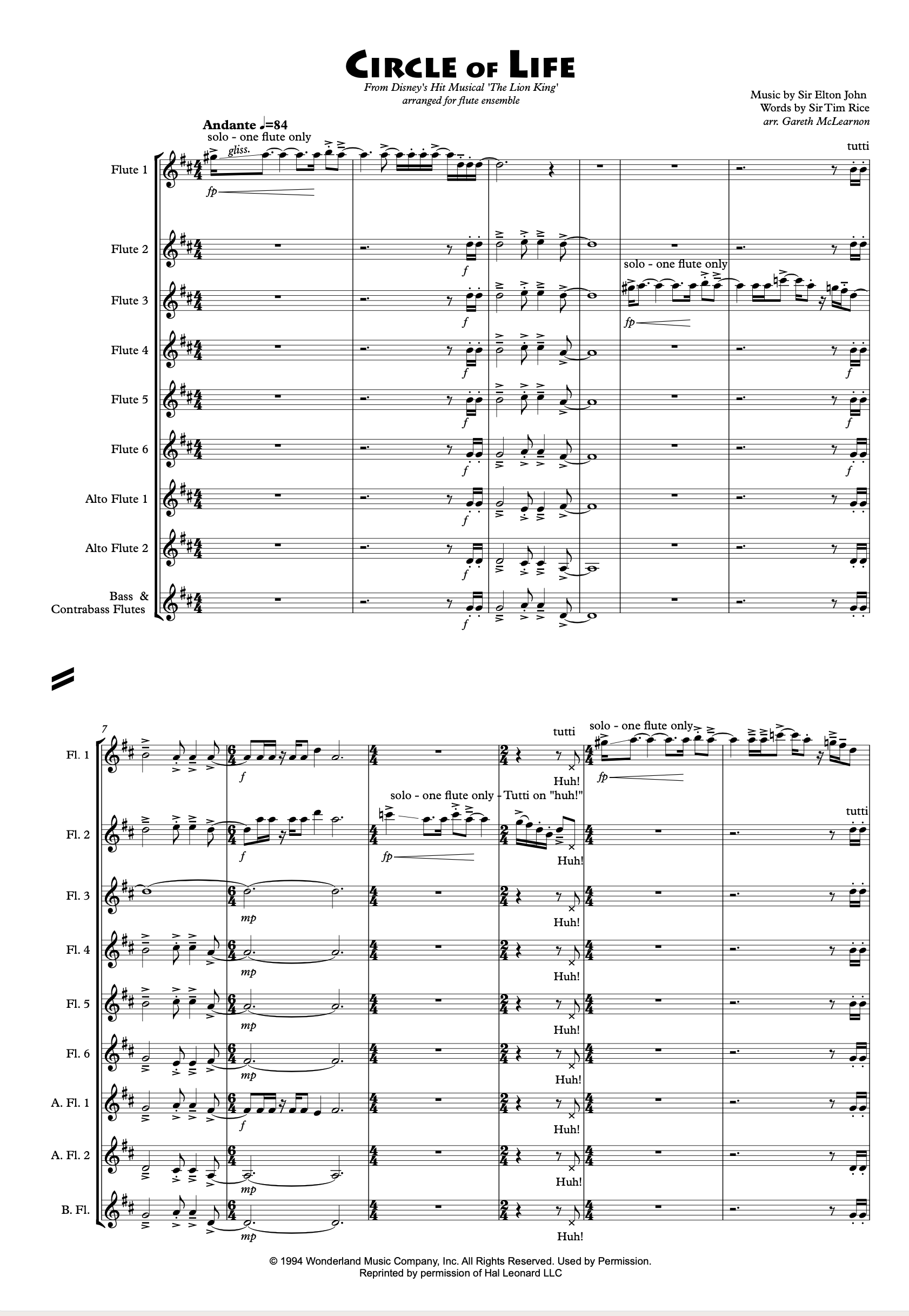
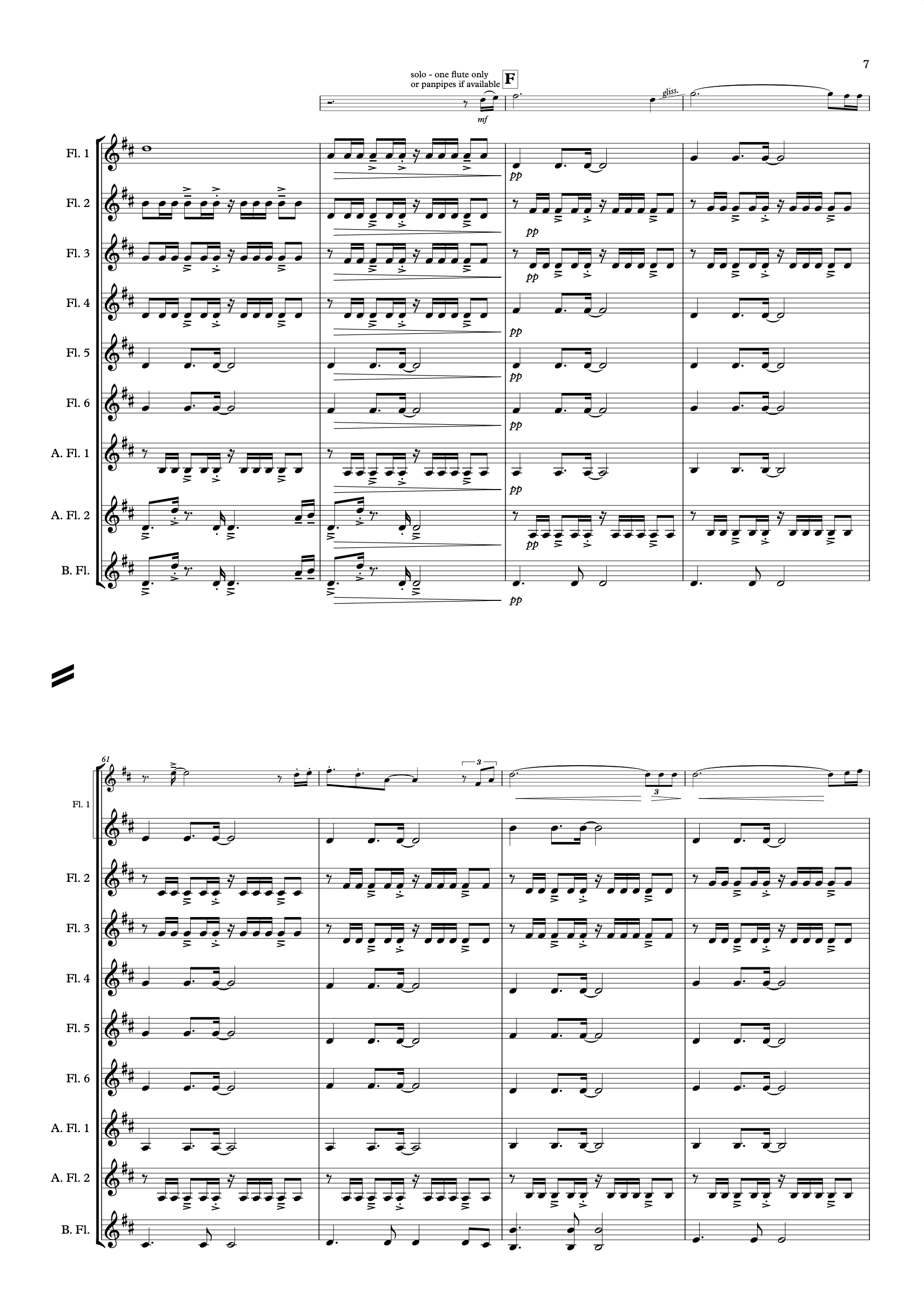
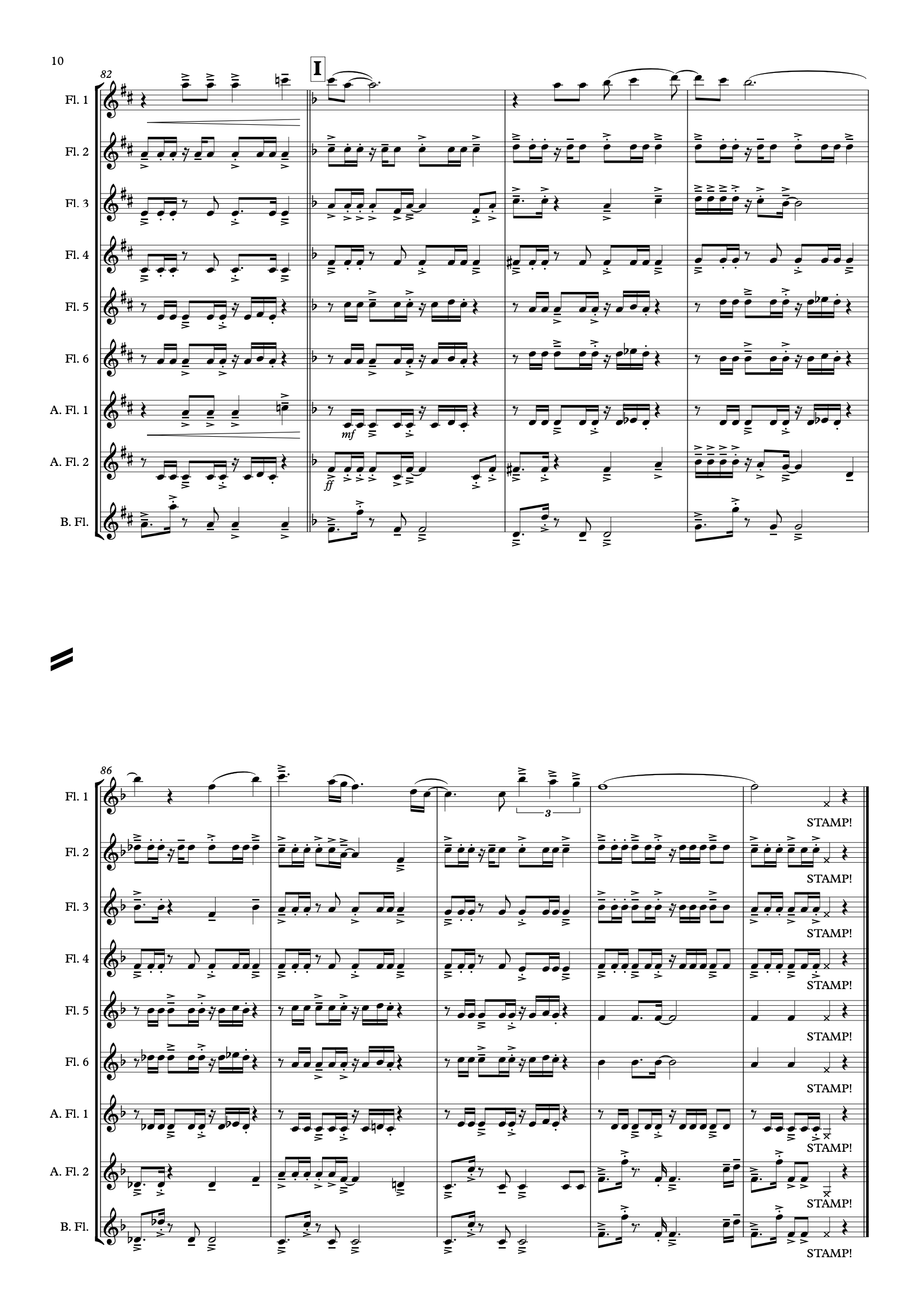
Circle of Life for Flute Ensemble
Circle of Life
There are few openings in musical theatre quite as electrifying as Circle of Life.
I played in both the West End and international touring productions of The Lion King, performing that extraordinary flute book many dozens, probably hundreds, of times. The part involves an almost ridiculous collection of instruments, including panpipes, bansuri, whistles and assorted other things, with around fifty instrument changes along the way.
And every night, when the lights went down and Circle of Life began, it was still exciting.
This flute ensemble arrangement grew directly out of that experience.
My aim was to capture the theatrical energy of the original. The excitement comes from rhythm, colour, tension and momentum rather than simply playing loudly. Done well, it should have exactly that gripping-the-programme feeling of a great opening number.
And audiences tend to love it.
Whoops, cheers and cries at the end are entirely normal.
Quick Details
Instrumentation: 6 Flutes, 2 Alto Flutes, Bass and/or Contrabass Flute
Featured solo material in Flutes 1, 2 and 3
Includes material suitable for a wide range of playing levels
Optional featured solo may be performed on panpipes, regular flute or another suitable instrument
Strong rhythmic and ensemble focus
Excellent educational repertoire for teaching complex rhythmic patterns
Works one player per part or as a larger flute choir
Particularly effective with approximately 10–50+ players
Huge theatrical finish
Suitable for concert, festival and large flute choir performances
From the Pit to the Flute Choir
My relationship with this music goes back to playing The Lion King professionally.
The flute chair in the show is enormous fun and completely bonkers. There are nineteen instruments involved, including panpipes, bansuri and whistles, with constant changes throughout the show.
Because I had lived inside the show for so long, I knew instinctively how Circle of Life was supposed to feel.
I knew where the energy needed to build.
I knew which harmonies had to land.
I knew where something that looked convincing on paper would feel awkward in performance.
So when I was putting together a musical-theatre-themed flute day, arranging it for flute ensemble seemed an obvious thing to try.
It went down extremely well.
Then people started asking if they could buy it. - I sought licensing permission - and here we are with an authorised edition of this fantastic piece!
Theatre Energy
The biggest challenge in performing this arrangement is avoiding the temptation to equate excitement with volume.
The opening of Circle of Life is electrifying because of its energy.
There is a tension and expectation in it that I always describe as that feeling of sitting in a theatre, gripping the programme, knowing something enormous is about to happen.
That is what I try to generate whenever I conduct the arrangement.
The very best performances have propulsion from the first sound and keep building from there.
Rhythm You Can Teach
One of the things I particularly enjoy about the arrangement is how useful it can be educationally.
The main melodic material is shared principally between the upper flute parts, while other players have increasingly complex rhythmic cells underneath.
Those patterns can be spoken, sung, clapped and learnt as rhythms before anybody even picks up a flute.
That makes the piece an excellent way of introducing less experienced players to rhythmic material which can initially look (very) intimidating on the page.
There is also an intentionally “very easy flute part”, consisting of little more than quarter notes.
I have conducted performances with more than 100 flute players, where very young players could simply join in and honk away enthusiastically on the easier material while advanced players handled the more demanding parts.
Everybody still contributes to the sound and energy of the piece.
The Opening
The arrangement remains very faithful to the atmosphere and structure I knew from performing the show.
It is even in the same key as the theatrical version.
That familiarity mattered enormously while I was writing it. I wasn't trying to reinvent the music. I wanted to translate the experience of performing it into the sound world of a flute ensemble.
The harmony, rhythmic drive and dramatic pacing all contribute to recreating that unmistakable opening atmosphere.
And yes, there is a “HUH!”
It needs commitment.
The Solo
Partway through the arrangement there is a featured solo which can be played on panpipes if you have somebody suitably adventurous available.
Over the years I've also heard it played on:
regular flute
fife
E-flat flute
various ethnic and folk instruments
So there is plenty of flexibility.
Panpipes are enormous fun and particularly appropriate given the original flute book, but nobody needs to go shopping before rehearsal.
A normal flute works perfectly well.
How Big an Ensemble?
I've recorded and performed the arrangement one player per part, and it works extremely well as chamber-style flute ensemble repertoire.
It also scales up very effectively.
Somewhere around 40–50 players is probably my personal sweet spot for a large performance. Beyond that, maintaining rhythmic definition and precision becomes increasingly difficult.
I've conducted it with more than 100 players and it can certainly create an enormous effect, but with a piece this rhythmically active I would always rather have fifty fully engaged musicians than a hundred people half participating.
A Rather Large Foot Stamp
The final moments gather all of that theatrical energy into one last gesture.
The entire flute ensemble delivers a massive collective foot stamp.
Properly committed to, it tends to bring the house down.
Subtle it isn't.
Around the World
Circle of Life has become one of my most widely performed flute ensemble arrangements and has been played by ensembles around the world.
One particularly memorable experience came at the South African Flute Festival, where I conducted it in both the Stellenbosch and Johannesburg legs of the festival.
There was something rather special about performing this music with a large flute ensemble in South Africa.
After years of playing it in theatres, arranging it, teaching it and conducting it around the world, it felt somehow as though the piece had travelled full circle.
Who Is It For?
This works particularly well for mixed-level flute ensembles.
There is substantial solo and technical material for stronger players, rhythmically interesting ensemble writing for developing musicians, and genuinely accessible material for less experienced flutists.
It therefore works particularly well for:
flute choirs with mixed ability levels
flute festivals
large community ensembles
youth and adult groups playing together
workshops focusing on rhythm and ensemble playing
musical-theatre-themed concerts
groups looking for a spectacular concert opener or closer
It can be performed with one player per part, but it also thrives with multiple players on each line.
Frequently Asked Questions
What is the instrumentation?
Six concert flute parts, two alto flute parts and one bass/contrabass flute part.
Are there solos?
Yes. Featured material appears particularly in Flutes 1, 2 and 3.
Do I need a panpipe player?
No. The featured middle solo can be played on regular flute. Panpipes, fife, E-flat flute and other suitable instruments have all been used in performances.
Can younger or less experienced players join in?
Yes. The arrangement contains material at several different levels, including an intentionally easy flute part.
Can it be performed one player per part?
Absolutely. I recorded it that way myself and it works extremely well.
Does it work for a large flute choir?
Very much so. I've conducted performances involving more than 100 players, although I particularly like the clarity and energy you can achieve with ensembles of around 40–50.
Is a conductor required?
For a large ensemble I would strongly recommend one. The rhythmic precision and theatrical pacing benefit enormously from somebody actively shaping the performance.
Should the final foot stamp be subtle?
Absolutely not.