Aurora for Flute Ensemble (2025)



Aurora for Flute Ensemble (2025)
Aurora
Aurora is an exuberant, space-age work for flute orchestra, written for an unusual double world premiere in the northern and southern hemispheres within the same 24 hours.
The piece came about because, rather inconveniently, I discovered that I had agreed to appear at both the Finnish Flute Festival in Helsinki and the Australian Flute Festival in Sydney on essentially the same dates in October 2025.
I had committed to Helsinki first, so that was the engagement I needed to honour.
But rather than simply accepting that I couldn't be in Australia as well, I started thinking about what might connect two flute festivals taking place almost simultaneously on opposite sides of the planet.
The answer was:
Aurora Borealis. Aurora Australis.
The Northern Lights and the Southern Lights.
That immediately became the starting point for a piece designed not just to be performed in both hemispheres, but to connect them.
The two performances ultimately took place within only a matter of hours of one another. We even exchanged videos between Helsinki and Sydney, metaphorically touching fingertips through the piece across thousands of kilometres.
Musically, Aurora begins as a shimmering, free, constantly changing soundscape before gradually clicking into a bright, thoroughly rhythmic world of groove, crunchy harmony and space-age optimism.
And because no two conductors will ever shape that opening in exactly the same way:
no two performances of Aurora can ever be identical.
Quick Details
Flute orchestra / large flute ensemble
Duration: approximately 7 minutes
4 Concert Flute parts
2 Alto Flute parts
Bass / Contrabass Flute part (with optional contra-specific writing from bar 79-94)
Written for a double premiere in Helsinki and Sydney
Inspired by the Aurora Borealis and Aurora Australis
Free, conductor-controlled opening
Approximately 4.3 quadrillion possible opening combinations
Followed by energetic, commercial and rhythmically driven writing
Requires a confident conductor
Particularly effective with multiple players per part
Extended techniques include:
Explosive Articulation
Residual Tone
Harmonic Bursts
tremolos used to create shimmering aurora effects
Includes an entire groove built from Explosive Articulation
Approximately 7 minutes
Printed score purchasers may request complimentary PDF individual parts
The published scoring is four concert-flute parts, two Alto parts and one Bass/Contrabass part, including optional Contrabass-specific writing.
Instrumentation & Player Levels
Flute 1
Advanced
Flute 2
Advanced
Flute 3
Intermediate
Flute 4
Intermediate
Alto Flute 1
Upper Intermediate to Advanced
Alto Flute 2
Upper Intermediate to Advanced
Bass Flute
Upper Intermediate to Advanced
Contrabass Flute, optional
Advanced
The four concert-flute parts follow a structure I use in a number of my larger ensemble works: the first two parts carry the stronger technical demands, while Flutes 3 and 4 are somewhat more accessible.
The doubled Alto Flute writing is particularly important to the sound of Aurora. I had become increasingly interested in what happens when the flute orchestra has enough independent voices below the normal concert-flute register. One Alto part simply wasn't enough. With two Altos, plus Bass and optional Contrabass material, I can create the thicker, richer and crunchier harmony that I naturally want to write.
That deeper harmonic palette became increasingly important in later works including DEEP DISH and Seconds on State Street.
Two Hemispheres, One Premiere
The unusual genesis of Aurora was entirely practical.
I was double-booked.
The Finnish Flute Festival and Australian Flute Festival were both taking place from 1–3/4 October 2025, and by the time I realised the clash I had already committed to Helsinki.
Once the initial panic subsided, the coincidence started to feel creatively useful.
What connected Finland and Australia?
What could exist in both the northern and southern hemispheres?
Aurora Borealis.
Aurora Australis.
That is why the main title is simply:
AURORA
with BOREALIS and AUSTRALIS sitting subtly behind it on the title page.
The Finnish and Australian performances took place within the same 24-hour period, only a matter of hours apart.
There is something I still find rather lovely about that: two enormous flute ensembles, separated by thousands of kilometres, playing the same brand-new piece almost simultaneously.
Sculpting the Northern Lights
The opening of Aurora was inspired partly by watching Jacob Collier control huge audience choirs.
What fascinated me was the sense that the conductor could create an enormous living sound simply by pointing, gesturing and manipulating different groups in real time.
I wanted that feeling with a flute orchestra.
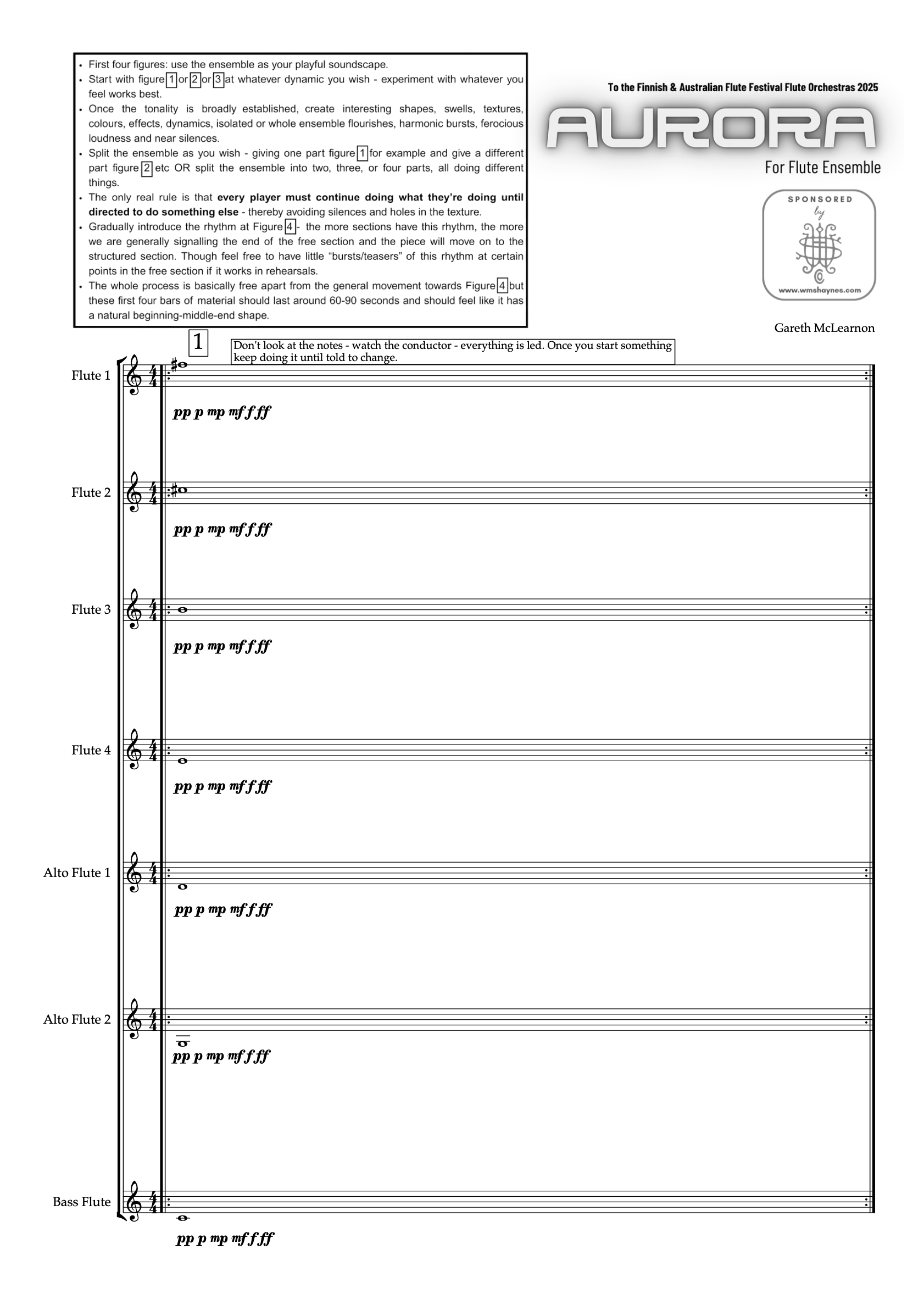
At the beginning of Aurora, each section of the ensemble is given a collection of four musical figures.
The conductor chooses:
which section enters
which figure they play
when they begin
the dynamic
when that sound should change
and which other sections are layered around it
Once a section has been activated, the players simply keep doing what they have been given until the conductor tells them otherwise.
So the conductor can gradually build, remove, brighten, darken and reshape the sound.
When it works well, it feels less like conventional conducting and more like operating an enormous musical light machine.
You make the smallest gesture...
and an entire section of the ensemble responds.
4.3 quadrillion beginnings. Apparently.
When I first worked out how many combinations were theoretically available in the opening, the numbers became rather silly.
Seven ensemble parts.
Four musical figures.
Multiple dynamic possibilities.
Different sections capable of entering simultaneously or independently.
I asked ChatGPT to help me calculate the number of possible combinations.
The answer came back at more than 4.3 quadrillion.
So I am cheerfully blaming ChatGPT for the mathematics.
The important point is less the exact number than the consequence:
the opening will never happen the same way twice.
Even the concert performance will not simply reproduce what happened in rehearsal.
That creates a little extra frisson for everybody involved.
The players have to watch.
The conductor has to make decisions.
And the ensemble has to react.
Stop looking at the music!
There is a rehearsal moment with Aurora that happens almost every time I conduct it.
A player has been asked to hold one note.
Or perhaps tremolo between two notes.
They know what they are playing. They are already playing it.
And yet they remain desperately focused on the sheet music.
At which point I tend to point out:
Your music has no more information to give you.
You already know the note. Stop looking at the page.
Look at me.
That is actually an important part of the piece.
The opening requires players to stop treating notation as the sole source of musical information and instead respond directly to gesture, sound and the musicians around them.
How the groove arrives
The first three figures in the opening exist without any real sense of pulse.
They shimmer.
They overlap.
They float independently.
Then comes Figure 4.
Figure 4 is in 4/4.
The moment it appears, something changes.
There is suddenly a pulse.
When I conduct the piece, I often introduce this figure first in the low flutes, although the score does not require it.
Gradually it spreads through the ensemble.
More and more players click into the same rhythmic world until eventually every section is playing Figure 4.
That is the signal.
The aurora has crystallised into rhythm.
And suddenly we're off.
From cosmic shimmer to space-age groove
Once the free opening has finished, Aurora moves firmly into the rhythmic language that appears throughout much of my music.
The published description calls it a mixture of a catchy melody, cross-rhythmic riff, thick crunchy chords and contemporary techniques.
The melody has a kind of optimistic retro-futurist quality to it.
Think:
Star Trek.
Space: 1999.
The Jetsons.
Not dark, terrifying outer space.
More the optimistic vision of the future where humanity has apparently solved all its problems and everybody owns an implausibly sleek spacecraft.
The melody moves around the orchestra against highly rhythmic writing and the thicker harmony made possible by the two Alto parts and low flutes.
Dancing light
The extended techniques aren't simply there for effect.
They are part of the aurora imagery itself.
Aurora uses:
Explosive Articulation
Residual Tone
Harmonic Bursts
Tremolos
In particular, the combination of tremolos with Harmonic Bursts creates one of the sounds I most associate with the piece.
Players rapidly alternate between pitches and then burst upward through the harmonic spectrum.
To me, those flashes of upper harmonics feel like light suddenly dancing through the texture.
They are little musical eruptions of colour.
The Explosive Articulation groove
At one point the entire flute orchestra effectively turns into a rhythm section.
There is a substantial passage in which the ensemble creates a huge groove almost entirely through Explosive Articulation.
It is one of my favourite moments in the piece.
A technique that could simply have been a strange flute sound suddenly becomes the rhythmic engine for the entire ensemble.
That contrast is important to Aurora: ethereal soundscape at one extreme, very physical groove at the other.
One last glimpse of the aurora
Near the end, the rhythmic machinery briefly gives way.
The shimmering tremolo material from the opening returns and, for a moment, the ensemble slips back into something freer and more improvisatory.
It is a brief reminder of where the piece began.
Then everybody clicks back into gear.
And we head towards the ending.
Which is not subtle.
I like atmospheric fade-outs.
I like tasteful endings.
I have even written a few.
But quite often, when I finish a piece, I want the audience to know:
YES. THAT WAS THE END.
So Aurora finishes with a huge, unequivocal:
BAM.
Perhaps that is shamelessly calculated to produce the best possible audience response.
I'm entirely comfortable with that.
How many players?
The score contains seven principal ensemble parts, so seven players represents the absolute practical minimum.
But that is not really how I imagine Aurora.
I want the parts doubled at minimum, and the opening becomes considerably more impressive as the ensemble grows.
The premiere performances involved very large flute orchestras:
around 80 players in Helsinki
approximately 100–120 players in Sydney
Personally, I particularly enjoy working with flute choirs of roughly 40–50 players.
That is large enough to create an enormous palette of colour while still allowing the conductor to feel that each section responds instantly.
But Aurora is deliberately scalable.
A good-sized community flute choir can perform it.
So can a vast festival orchestra.
Does it need a conductor?
Absolutely.
And ideally, a confident one.
The conductor is not merely keeping time in Aurora.
Particularly in the opening, the conductor is effectively composing the performance live.
They have to decide what they want to hear, communicate it clearly, listen to what the ensemble gives back, and decide what happens next.
The players likewise need to watch constantly and respond immediately.
That relationship between conductor and ensemble is one of the things that makes the piece so satisfying to perform.
Performance History
Aurora received its unusual double premiere at the Finnish Flute Festival in Helsinki and the Australian Flute Festival in Sydney in October 2025.
The performances took place within the same 24-hour period, linking the northern and southern hemispheres through the concept that had inspired the piece in the first place.
Selfie videos were even exchanged between the two groups, creating a small human connection between musicians who were simultaneously giving life to the same piece on opposite sides of the planet.
Later in 2025, I conducted Aurora at the major French flute convention in Paris.
The piece has continued to be performed elsewhere internationally and is also part of the programme for the German Flute Festival in September 2026.
Because of the conductor-controlled opening, every one of those performances is not merely an interpretation of the same work.
Structurally and sonically, each is genuinely unique.
Printed Score + Complimentary PDF Parts
Because Aurora is conceived as a flute orchestra work with multiple players per part, purchasers of the printed score may also request a complimentary PDF set of the individual flute parts during checkout.
This makes it practical to distribute the music to larger festival, school, university and community flute ensembles.
Frequently Asked Questions
What level is Aurora?
The ensemble combines more demanding and more accessible writing. Flutes 1 and 2 are Advanced, while Flutes 3 and 4 are Intermediate. The Alto, Bass and optional Contrabass material is best suited to confident Upper Intermediate or Advanced low-flute players.
Does Aurora require a conductor?
Yes. A strong conductor is central to the piece, particularly during the free opening where the structure is created live through gesture.
Is the opening actually improvised?
The musical material itself is provided, but its combination, order, dynamics and layering are controlled spontaneously by the conductor. It is therefore a form of controlled aleatoric writing.
Will every performance really be different?
Yes. The conductor has enormous freedom in the opening, so even two performances by the same ensemble can have noticeably different structures, lengths and textures.
Where does the figure of 4.3 quadrillion possible beginnings come from?
It comes from combining the many possible ensemble sections, four musical figures and multiple dynamic choices available in the opening. The calculation was made with a little help from ChatGPT, so the word “apparently” is probably advisable.
Why are there two Alto Flute parts?
Two independent Altos allow much richer harmony below the normal concert-flute register. That thicker low end has become an increasingly important feature of my flute-orchestra writing.
Can I use a Contrabass Flute?
Yes. The Bass/Contrabass part includes optional writing specifically for Contrabass Flute, including a separate low line in part of the piece. The current edition specifies optional contra material at bars 79–94.
What extended techniques are used?
The piece includes Explosive Articulation, Residual Tone, Harmonic Bursts and tremolo effects. There is also a substantial ensemble groove constructed from Explosive Articulation.
How many players do I need?
Seven is the theoretical minimum, but Aurora is intended as flute-orchestra repertoire and is much more effective with doubled parts. It works particularly well with large festival ensembles.
How long is Aurora?
Approximately 7 minutes, with some natural variation according to how the conductor shapes the opening.
Are complimentary PDF parts available?
Yes. Purchasers of the printed score may request complimentary PDF individual parts for ensemble distribution.