So Many Themes, So Little Time for Flute Ensemble (2024)
So Many Themes, So Little Time for Flute Ensemble (2024)
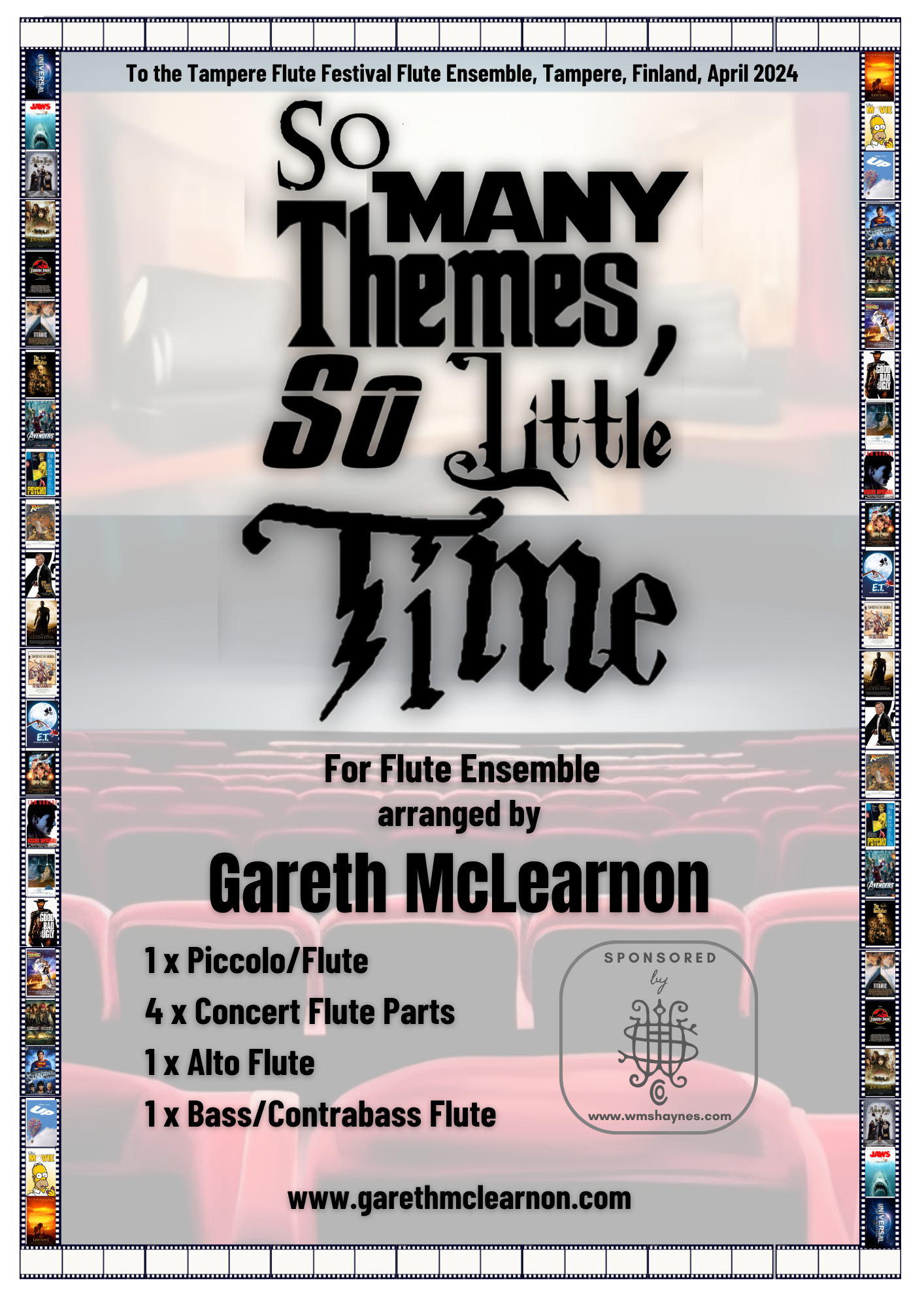
So Many Themes, So Little Time
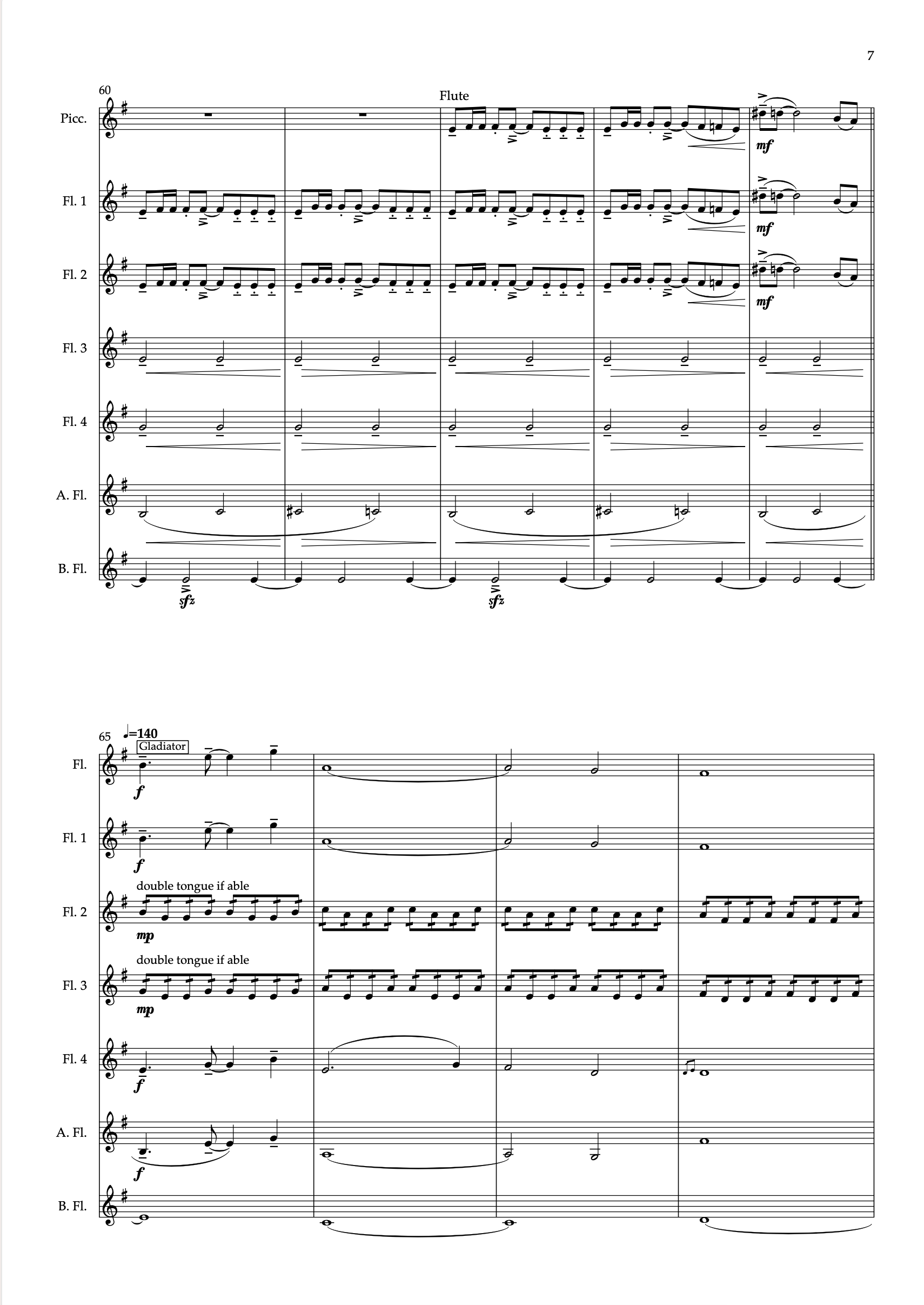
24 famous screen themes. About five minutes. Almost no warning between them.
Described on the score as “A parody for copyright reasons”, So Many Themes, So Little Time is a comical, whiplash-inducing sprint through some of the most recognisable music from film and television.
Each theme lasts only long enough for the audience to realise what they are hearing.
Then it’s gone.
No elegant transitions. No tasteful linking passages. Just enormous musical gear changes, one after another, at a speed which means the audience is frequently still thinking “Oh! That was…” while the ensemble is already halfway through the next one.
It has been performed all over the world, and happily the thing that matters most has happened every time: PEOPLE LAUGH!
Quick Details
Instrumentation: Piccolo doubling Flute, 4 Flutes, Alto Flute, Bass Flute
Contrabass Flute strongly recommended doubling the Bass part where available
Duration: approximately 5 minutes
24 instantly recognisable film and television themes
Intermediate to Advanced
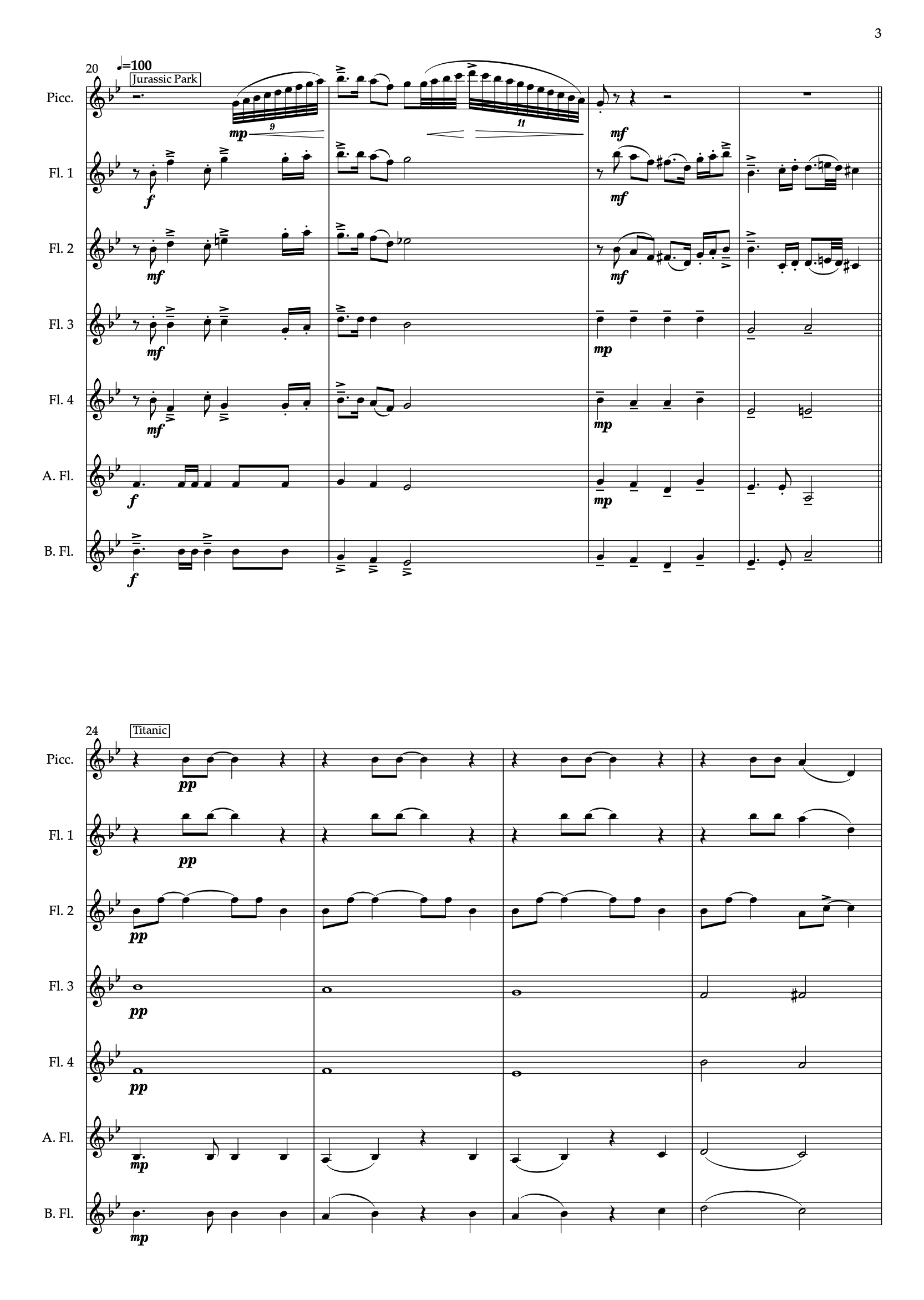
Fairly demanding Piccolo, Flute 1, Flute 2 and low-flute writing
Flutes 3 and 4 somewhat less demanding, but with their own moments to shine!
One player per part works fine if needed.
Also effective as a flute choir with multiple players per part
Around 40–50 players is an excellent maximum for retaining rhythmic clarity
Conductor pretty much essential
Rehearsal video available (and encouraged!)
Dedicated to the Tampere Flute Festival
Ends with a very large collective foot stamp
How This Happened
This piece exists because somebody advertised a concert before asking me what music I actually had.
I was appearing at the Tampere Flute Festival in Finland, and the participant flute choir had been advertised under the theme “Music of the Silver Screen.”
Then came the fairly reasonable question:
“Do you have anything film-music-ish? Harry Potter? Titanic? Lord of the Rings?”
Well…
No.
Writing an entire new arrangement of a major film score wasn't particularly appealing, so I began wondering whether something much shorter, faster and considerably sillier might work instead.
The basic idea appeared:
What if we raced through tiny snippets of loads of them?
And once that thought arrived, things advanced/deteriorated quite quickly.
Twenty-Four Themes
I already had a fairly substantial list, but I put the question to the Flute Forum community on Facebook:
If you were making a ridiculously fast medley of famous film music, what absolutely had to be included?
That supplied even more ideas.
I then made myself a master sheet containing only the melodies.
No orchestration.
No transitions.
Just tune after tune after tune.
The game became working out what should follow what.
Sometimes two ideas complement one another.
Sometimes the funniest possible decision is to make them violently disagree.
Comedy by Gear Change
There is no original connecting material between the themes.
One finishes and the next one simply arrives.
Sometimes a single note provides just enough common ground to throw us into an entirely different musical universe.
I deliberately resisted making the transitions elegant.
Frankly - elegance isn’t funny.
The comedy comes from those huge, clunking gear changes.
One moment can be dark, expansive and cinematic. A few seconds later we are somewhere completely different.
Probably the most reliable laugh comes from Psycho straight into Indiana Jones.
You get the hideous, high-pitched screeching of one and then, almost immediately, that magnificently jaunty march barrels through the door.
It works. Every time.
Blink and You've Missed It
The extracts aren't so short that the audience has no chance of recognising them, that would defeat the whole point.
Each theme is allowed JUST enough time to establish itself.
The instant you think you know what it is, we leave.
Not before.Definitely not after.
That creates a rather wonderful delay in the audience.
You can almost feel recognition moving around the room:
“Oh…”
“Oh!”
“THAT'S…”
Too late.
Next one.
With twenty-four of them packed into roughly five minutes, most listeners recognise the great majority, although almost everybody seems to have a few which briefly escape them.
What's In It?
The whirlwind includes music associated with:
Lawrence of Arabia
E.T.
Harry Potter
Mission: Impossible
Star Wars
The Good, the Bad and the Ugly
Back to the Future
Pirates of the Caribbean
Superman
Up
The Simpsons
The Lion King
Universal
Jaws
The Addams Family
The Lord of the Rings
Jurassic Park
Titanic
The Godfather
The Avengers
Psycho
Indiana Jones
James Bond
Gladiator
That really is quite a lot of cinema for five minutes.
The Piccolo Player
The Piccolo part needs a competent player.
There is plenty of exposed writing, fast scales and general whizzing about, and because the piccolo frequently sits on top of the texture there is nowhere particularly useful to hide.
The player also doubles Flute meaning that whenever the piccolo isn't needed, they can join the ensemble rather than standing around wondering what to do with themselves.
The Rest of the Ensemble
Flutes 1 and 2 carry some of the more demanding material.
Flutes 3 and 4 have a slightly easier ride overall, although every player eventually gets a moment where the musical spotlight lands squarely on them and they have to deliver.
The Alto and Bass writing is substantial and requires confident players.
And if you have access to a Contrabass Flute, please use it.
The piece contains Jaws so this is not really the moment to economise on bass.
The Contrabass can double the Bass part and gives the whole arrangement considerably more cinematic weight.
One Per Part or Flute Choir?
Both work.
I recorded the piece one player per part, and the clarity and precision can be fantastic that way.
It also works extremely well as a flute choir.
As with several of my larger ensemble pieces, somewhere around 40–50 players is probably the upper end of my personal sweet spot.
Once an ensemble becomes enormous, keeping all those abrupt rhythmic and stylistic changes genuinely sharp becomes increasingly difficult.
The whole piece depends on commitment and precision. Nobody gets to be a passenger.
You Need a Conductor
Yes. Absolutely.
The ensemble moves between completely different musical worlds every few seconds. Somebody needs to be in charge of the traffic.
The conductor controls those gear changes, keeps the rhythmic language tight and, crucially, controls the comic timing.
A transition which is vaguely together is messy.
A transition which lands absolutely together is funny.
There is a rehearsal video available, and I strongly encourage players to use it before the first rehearsal.
I also normally ask them to leave a comment telling me their favourite moment.
This is partly to prove they've watched it.
And partly to improve my YouTube statistics.
Everybody wins!
Tampere
So Many Themes, So Little Time was written for and is dedicated to the Tampere Flute Festival in Finland, where it received its first performance.
Since then it has travelled extensively. Circling the globe many times.
Different audiences naturally express humour in different ways, but the arrangement has produced audible laughs in performances across cultures.
I was particularly pleased that even its original Finnish audience was chuckling.
That felt like a useful benchmark.
The Ending
After twenty-four themes, subtlety seems unnecessary.
The final stretch draws on music from the very end of The Lion King rather than the opening represented in my separate Circle of Life arrangement.
It gives the piece a much grander final build.
Then the entire ensemble finishes with a massive foot stamp.
By this stage the audience has survived approximately five minutes of musical whiplash, and usually they generally seem quite happy about it.
Frequently Asked Questions
How long is it?
Approximately five minutes.
How many themes are there?
Twenty-four.
(Yes, really.)
Do the themes overlap?
No. The comedy depends largely on one musical world being replaced brutally by the next.
Is there connecting material between the themes?
Essentially none. The abrupt transitions are fundamental to the piece.
Can it be performed one player per part?
Yes, and it works extremely well that way.
Does it work for a large flute choir?
Yes. Around 40–50 players can produce a terrific result while retaining clarity.
Do I need a Contrabass Flute?
No, but if one is available I very strongly recommend using it to double the Bass part.
Does the Piccolo player need to be strong?
Yes. The Piccolo/Flute part is advanced, exposed and technically active.
Do I need a conductor?
Yes. With twenty-four musical gear changes in five minutes, this is not the moment for democracy.
Is there a rehearsal resource?
Yes. A rehearsal video is available to help players become familiar with the themes, rhythms and rapid transitions before the first rehearsal.
Does it actually get laughs?
So far, yes. Which is fortunate - as I’m banking on the comedy to reinforce the parody aspect of the piece!