Fourmies-Dabble for Junior Flute Ensemble (2025)
Fourmies-Dabble for Junior Flute Ensemble (2025)
Fourmies-Dabble
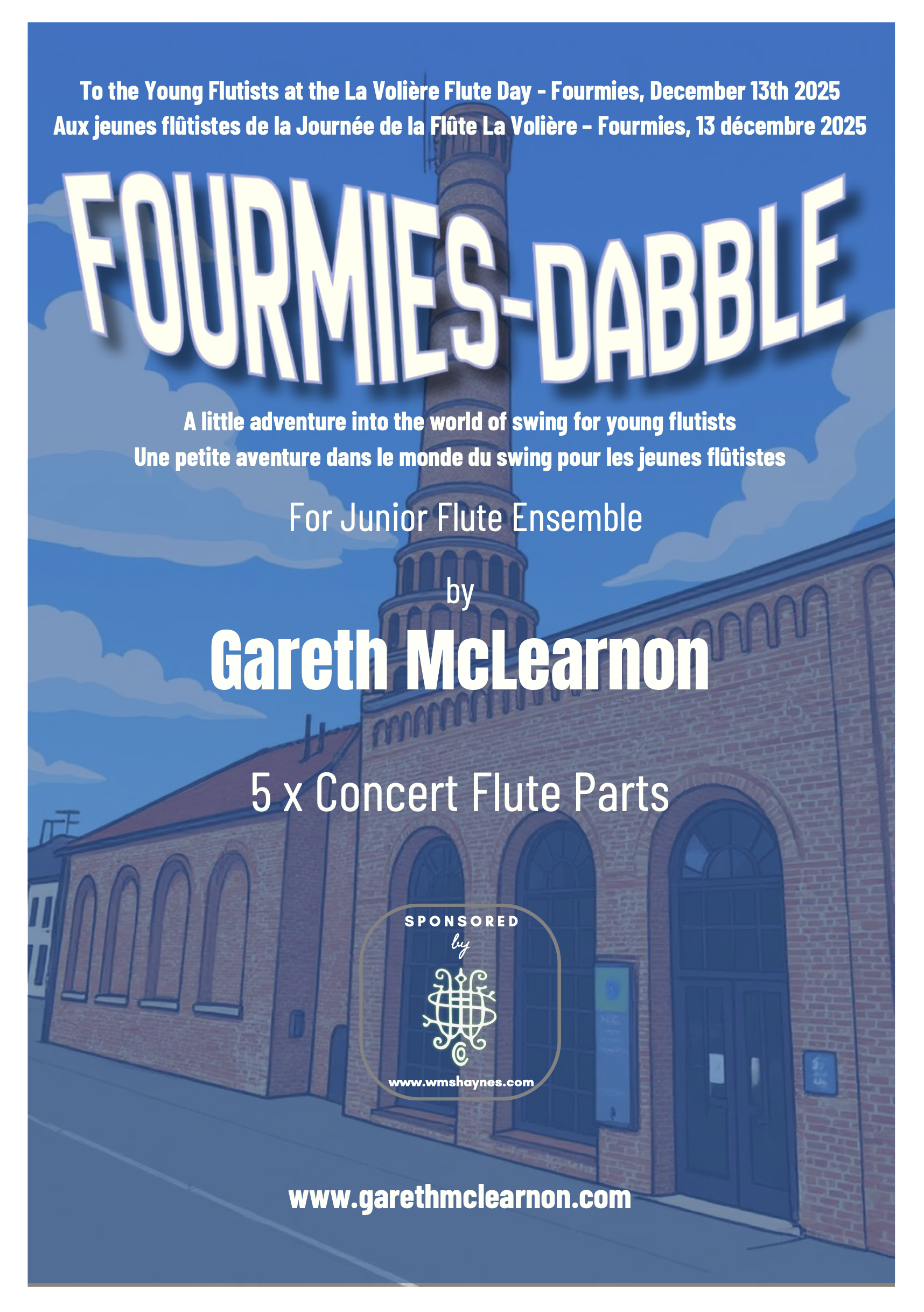
Fourmies-Dabble is a fun, swinging introduction to jazz, improvisation, extended techniques and rhythmic independence for junior flute ensemble, written for five progressively graded concert-flute parts.
And technically, it is a piece that I had already said I wasn't going to write.
In 2025 I was in the middle of several other large projects, including Roots for flute and piano, Aurora for flute ensemble and an arrangement of the Finnish folk song The Sky Is Blue and White. When I was asked by La Volière Flute Orchestra if I could write a new children's piece for their annual Flute Day in Fourmies, northern France, my answer was quite straightforward:
No. I don't have time.
Then I put the phone down.
And almost immediately the name Fourmies collided in my head with Charles Aznavour's Formidable, a bit of swing, and the English word dabble.
Suddenly I had an idea.
Fourmies-Dabble became exactly what its title suggests: a chance for young flute players to dabble in musical things they may not yet have encountered very often in their classical training.
Swing.
Improvisation.
The blues.
Extended techniques.
And, most importantly, the idea that making music sometimes means getting your eyes off the page, listening to everybody around you and being brave enough to invent something yourself.
Quick Details
Junior flute ensemble / junior flute choir
Duration: approximately 5 minutes
5 Concert Flute parts
Parts progressively graded from Flute 1 to Flute 5
Suitable for Beginner through Upper Intermediate junior players
Written for anything from one player per part to a large flute choir
World premiere performed by approximately 50 young flutists
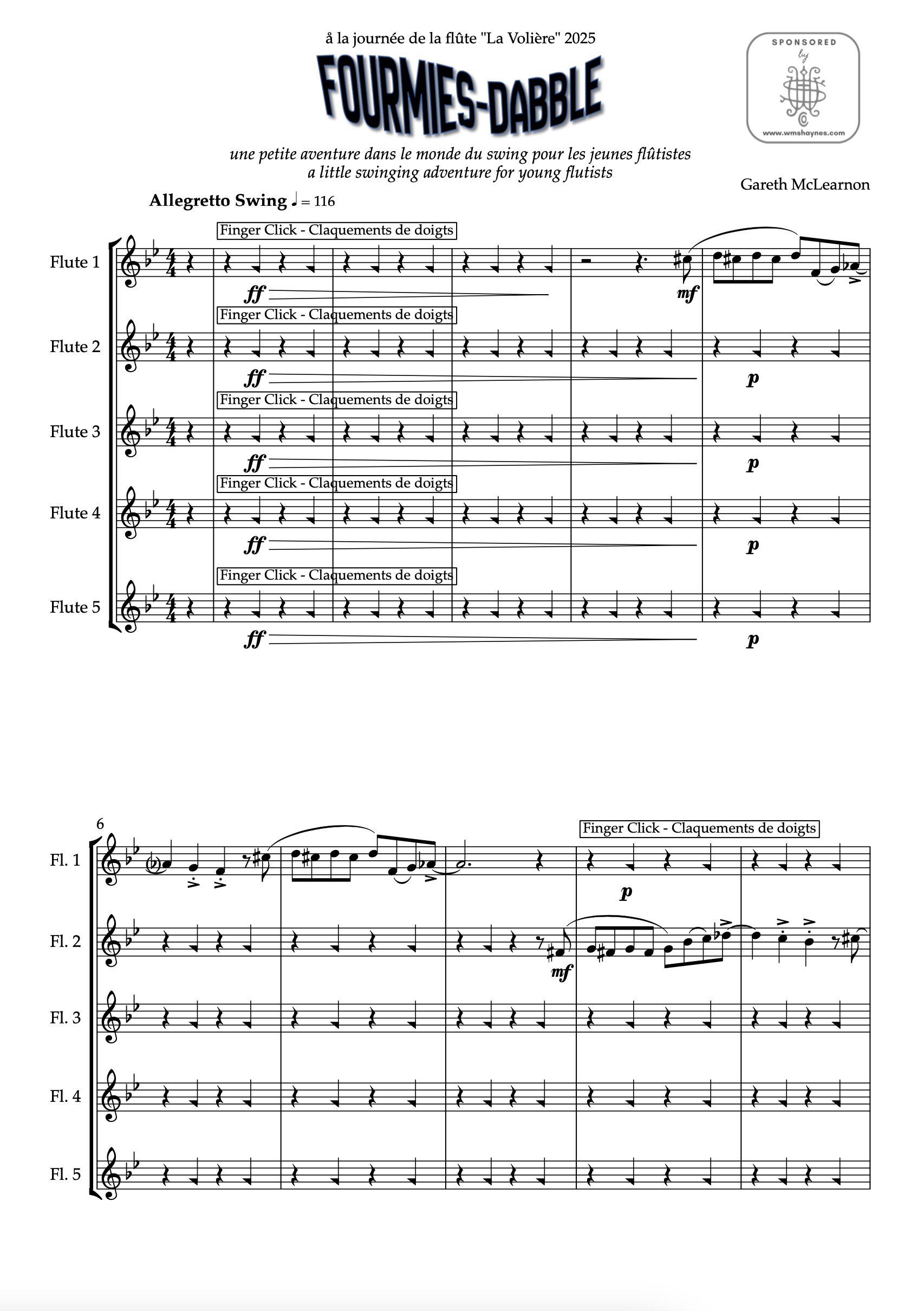
Introduces swung eighth notes
Includes a 12-bar blues improvisation section
Three opportunities for improvised solos or duos
Extended techniques include:
Explosive Articulation
Finger Clicks
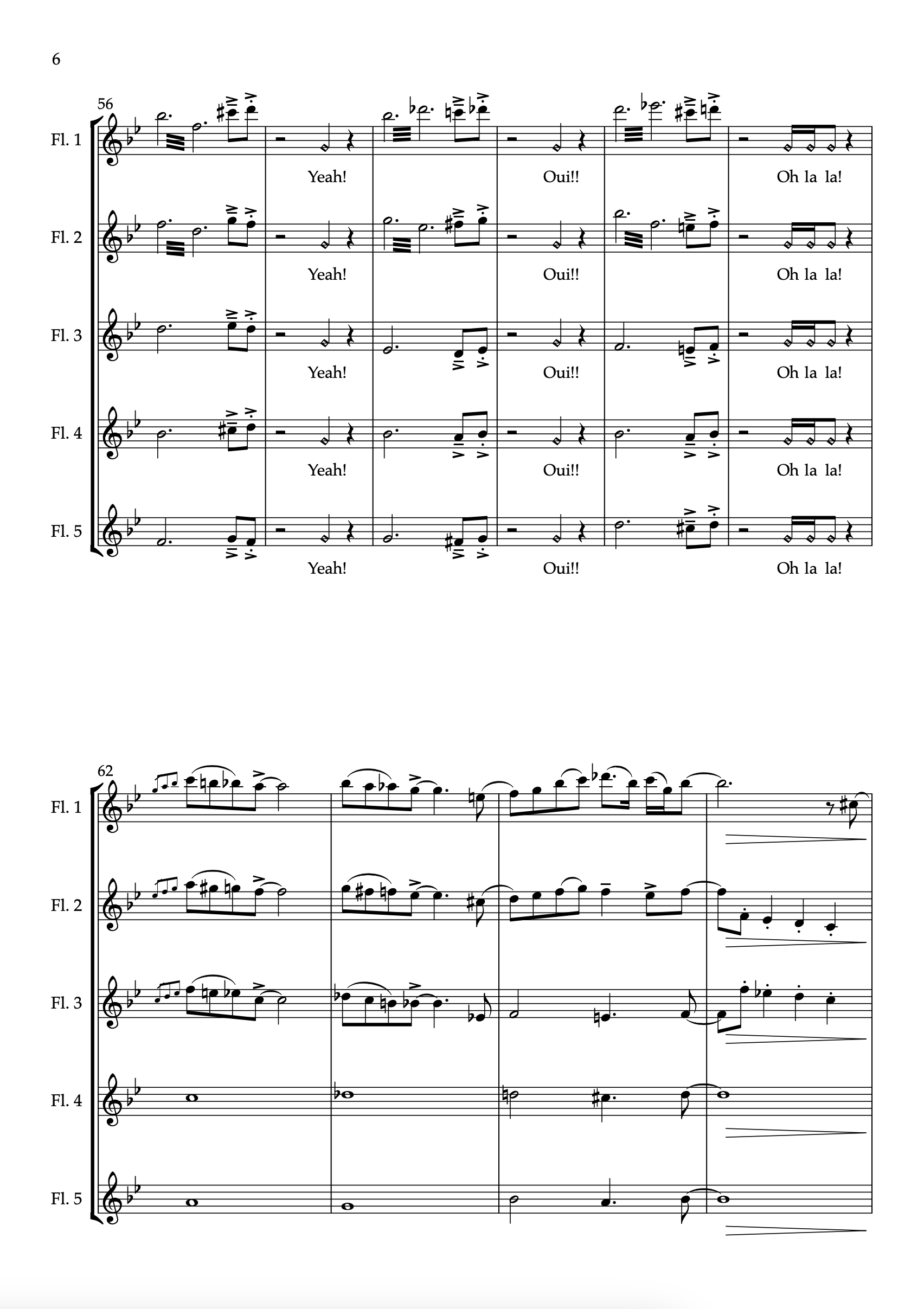
Jet Whistles
Can be performed with or without a conductor
Rehearsal resources are available to help players and directors prepare the piece
Commissioned by La Volière Flute Orchestra
World premiere in Fourmies, France, December 2025
Since performed internationally
Printed score purchasers may request complimentary PDF individual parts
Instrumentation & Player Levels
Flute 1
Upper Intermediate – Advanced Middle School
Flute 2
Intermediate – Strong Middle School
Flute 3
Developing Intermediate – Average Middle School
Flute 4
Developing – typically around 18+ months of playing
Flute 5
Beginner – suitable for relatively inexperienced players
As with HOT METZ, the five parts are deliberately arranged in descending order of difficulty.
Flute 1 carries the strongest material, while Flute 5 is genuinely accessible.
But easier does not mean irrelevant.
Every player has a musical job to do, and the writing is carefully constructed so that less experienced players are helped by what they hear happening around them.
My basic principle remains:
Every player should feel engaged and stretched, but nobody should feel overwhelmed.
Why Fourmies-Dabble?
The title came before almost everything else.
I had been invited to write something for a children's flute day in the northern French town of Fourmies.
Initially, I said no.
I simply had too much music to write already.
But after the conversation ended, the sound of the word Fourmies somehow connected in my head with the famous Charles Aznavour song Formidable and its swinging character.
Then came the word:
dabble
To dabble in something means to try it, experiment with it or explore it without needing to become an expert.
And that was suddenly the whole piece.
This would be a chance for young classical flutists to have a little dabble in swing, improvisation, blues and extended techniques.
So the piece I didn't have time to write became rather difficult not to write.
Learning to Swing
One of the central ideas in Fourmies-Dabble is something deceptively simple:
swung eighth notes.
For a player who has spent most of their musical education being taught to reproduce rhythms precisely as they appear on a page, swing introduces a rather wonderful complication.
The page doesn't tell you absolutely everything.
You have to listen.
You have to understand the style.
And eventually, you have to feel it.
That makes swing an extremely useful thing to introduce to young classical musicians.
The commercial and jazz-influenced rhythmic language of the piece gives them an opportunity to discover that two identical-looking eighth notes can behave completely differently according to musical style.
Learning Rhythm by Listening
I use the same deliberate teaching device here that appears in HOT METZ.
If there is a rhythmic idea that might prove challenging for one of the easier parts, I don't simply drop it on that player without warning.
The stronger players encounter it first.
A figure might begin in:
Flute 1
then pass to:
Flute 2
then:
Flute 3
and finally reach:
Flute 4
By the time the less experienced player has to perform it, they may already have heard the same rhythm several times.
That is completely deliberate, and I am entirely unapologetic about it.
It works.
Instead of asking a child to decipher an unfamiliar commercial-style rhythm in isolation, we allow their ears to teach them before their eyes have to deal with it.
And then we improvise...
This is where Fourmies-Dabble takes a significant step beyond HOT METZ.
In the middle of the piece, the players encounter a 12-bar blues framework with three opportunities for improvised solos.
These can be given to individual players or treated as little improvised conversations between two players.
And for many young classical musicians, the word improvise is considerably more frightening than any collection of written notes I could put in front of them.
So I try to remove the fear first.
One of my favourite demonstrations is to improvise a solo using basically one note.
A middle B-flat.
Again.
And again.
And again.
Change the rhythm. Change the articulation. Leave some space. Answer somebody else's phrase.
Suddenly that one note doesn't merely sound acceptable.
It sounds cool.
And the child discovers that improvisation doesn't require them to invent a hundred brilliant notes on the spot.
It starts with listening and making a choice.
There are no wrong notes. Sort of.
I often tell young players:
There are no wrong notes, although some notes will work better than others.
Then I prove it.
First, I might improvise using notes that sit comfortably inside the B-flat blues sound-world.
Then I will deliberately play what we might traditionally call a series of “wrong” notes.
F-sharps. E naturals. A naturals. Notes which can sound thoroughly uncomfortable if you simply land on them without knowing what to do next.
And then I do it again.
Except this time I make those same notes work.
I lead into them. Resolve them. Treat them as tension. Make them part of a phrase.
The point is not to teach a ten-year-old a lecture about advanced jazz harmony.
The point is to show them:
You played something unexpected. The world did not end. Now listen to it and decide where to go next.
That is a much more useful introduction to improvisation than simply giving somebody a scale and saying, “Right, off you go.”
A flute choir, not just a quintet
Although Fourmies-Dabble has five written parts, it was conceived as a flute choir work, not necessarily as a one-player-per-part chamber piece.
The world premiere involved approximately 50 young players.
I have also worked on it with much smaller groups, including around two players on each part, and it can equally well work with just five sufficiently confident players.
So the scoring is extremely flexible:
5 players? Fine.
10 players? Great.
50 excited children with flutes? Amazing.
That makes it particularly useful for:
Junior flute days
School ensembles
Community flute choirs
Summer schools
Mixed-level workshops
Massed flute ensembles
Extended Techniques
Fourmies-Dabble introduces young players to several contemporary flute sounds in an accessible musical context:
Explosive Articulation
Finger Clicks
Jet Whistles
The point isn't simply to tick a box marked “extended techniques”.
These sounds become part of the groove, colour and character of the piece and give younger players another opportunity to discover that the flute can do considerably more than simply play a succession of nice notes.
Does it need a conductor?
Not necessarily.
With a large junior ensemble, particularly one involving very young players, a conductor can obviously be extremely useful.
But the piece can also be led from within the ensemble or performed unconducted by a secure smaller group.
The improvisation sections in particular benefit from players learning to listen across the ensemble rather than relying exclusively on somebody waving their arms at the front.
From Fourmies to further afield
Fourmies-Dabble was commissioned by La Volière Flute Orchestra for their Flute Day in Fourmies, in the Hauts-de-France region of northern France.
The world premiere took place there in December 2025, with approximately fifty young flute players.
The rehearsal process was great fun and the first performance was enthusiastically received.
And despite being written for a very specific flute day in a small town in northern France, the piece quickly travelled.
It has already been performed internationally, including in Australia, South Africa, USA, UK and Finland, as well as elsewhere in Europe.
There appears to be a real appetite for original repertoire which allows junior flute ensembles to explore this sort of musical language without requiring advanced technique first.
HOT METZ and Fourmies-Dabble
The two pieces are deliberately related.
Both were written specifically for junior flute ensemble.
Both use five progressively graded flute parts.
Both use listening and repetition to help less experienced players deal with rhythmic material.
Both include extended techniques.
And both are supposed to be fun to rehearse, fun to play and fun to listen to.
But they approach those goals from slightly different directions.
HOT METZ focuses particularly on commercial-style groove, rhythmic confidence and ensemble effects.
Fourmies-Dabble takes another step into swing, blues and improvisation, encouraging players to move beyond reproducing the printed page and begin making musical decisions for themselves.
They can certainly be performed in the same concert, although they are close enough in spirit that I would probably put another contrasting piece or two between them rather than programming them back-to-back.
Think of them as:
two sides of the same slightly mischievous coin.
Listen & Learn
A rehearsal video is available in which I record the individual parts, conduct the music and explain some of the ideas behind the piece.
I make these resources for many of my flute ensemble works because I want players to have more than just the printed notes.
For Fourmies-Dabble, that is particularly useful for introducing:
the swing feel
rhythmic style
extended techniques
ensemble coordination
the improvisation sections
For a young player encountering these ideas for the first time, hearing what something is supposed to feel like can be far more helpful than another paragraph of written instructions.
Printed Score + Complimentary PDF Parts
Because Fourmies-Dabble is designed as a flute choir work with multiple players on each part, purchasers of the printed score may also request a complimentary PDF set of the five individual flute parts during checkout.
This allows teachers and ensemble directors to distribute parts conveniently to larger groups without repeatedly photocopying the printed edition.
Frequently Asked Questions
What level is Fourmies-Dabble?
It is written for junior flute ensemble, with five progressively graded parts ranging from Upper Intermediate in Flute 1 to Beginner in Flute 5.
Do players already need to know how to swing?
No. Introducing and developing a basic swing feel is one of the purposes of the piece.
Do the players have to improvise?
The piece provides three opportunities for improvisation within a clear 12-bar blues framework. These can be approached very simply, including solos using only a tiny number of notes.
What if a child is frightened of improvising?
Start with one note. A good rhythm played confidently on one B-flat can make a completely convincing solo. The aim is to introduce musical freedom without making it intimidating.
What scale or harmony is used for the improvisation?
The improvisation is based around a B-flat blues framework, giving players a clear and recognisable harmonic environment in which to experiment.
Can two players improvise together?
Yes. The solo opportunities can also become little improvised dialogues between two players, allowing them to listen and respond to one another.
Does it use extended techniques?
Yes. These include Explosive Articulation, Finger Clicks and Jet Whistles.
Is it one player per part?
It can be, but it doesn't have to be. Fourmies-Dabble was designed for flute choir and works very well with multiple players on each of the five parts.
Does it require a conductor?
No. A conductor is useful for a large or inexperienced group, but smaller secure ensembles can perform it without one.
How long is Fourmies-Dabble?
Approximately 5 minutes, depending slightly on the handling of the improvisation sections.
How is it different from HOT METZ?
The two works share the same mixed-level junior-flute philosophy, but Fourmies-Dabble focuses more specifically on swing, blues and improvisation, while HOT METZ is more strongly centred on commercial groove and rhythmic confidence.
Are complimentary PDF parts available with the printed score?
Yes. Because this is a flute choir work intended for multiple players per part, purchasers of the printed edition can request complimentary PDF individual parts.


