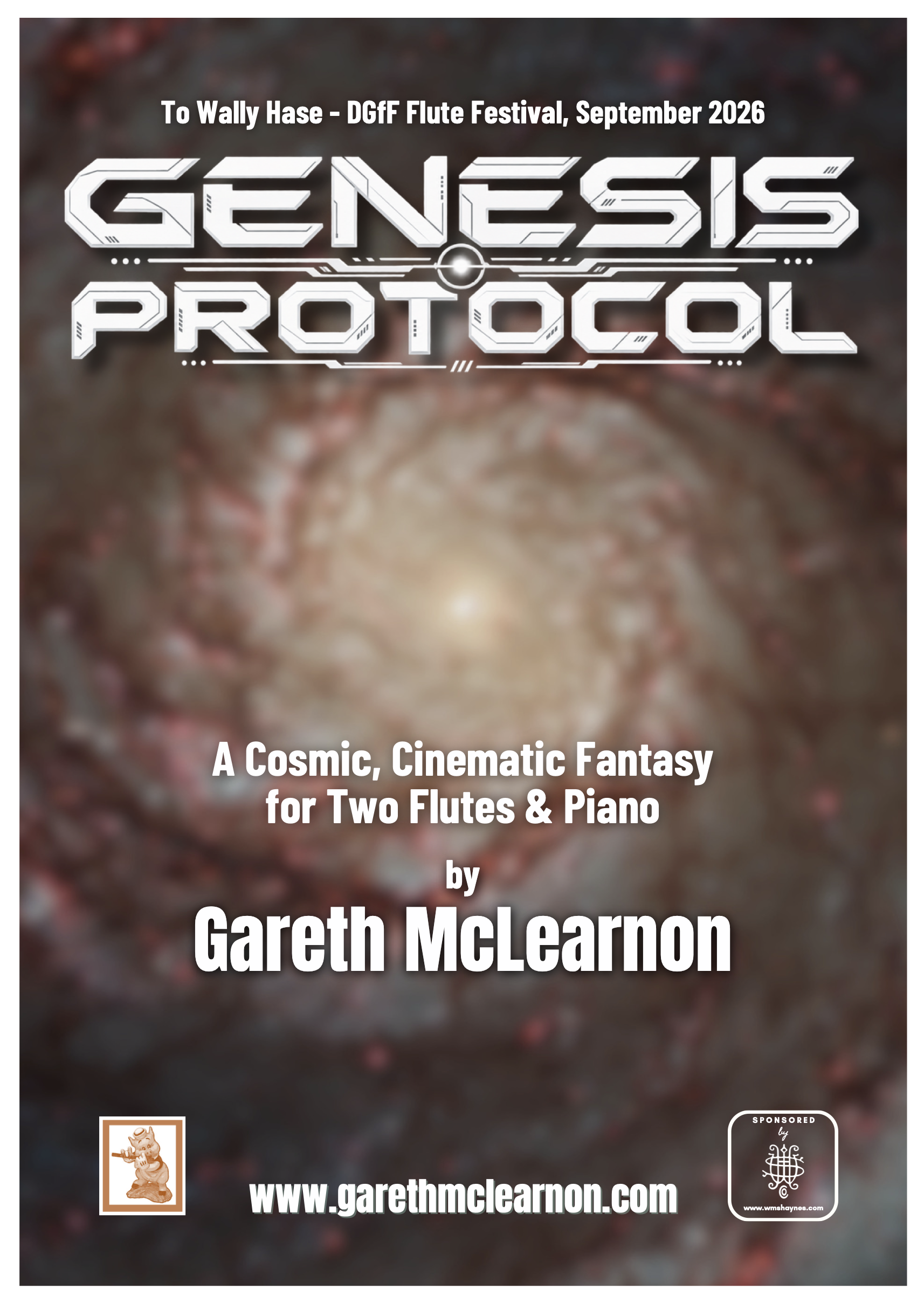
"Roots" for Flute & Piano (2025)

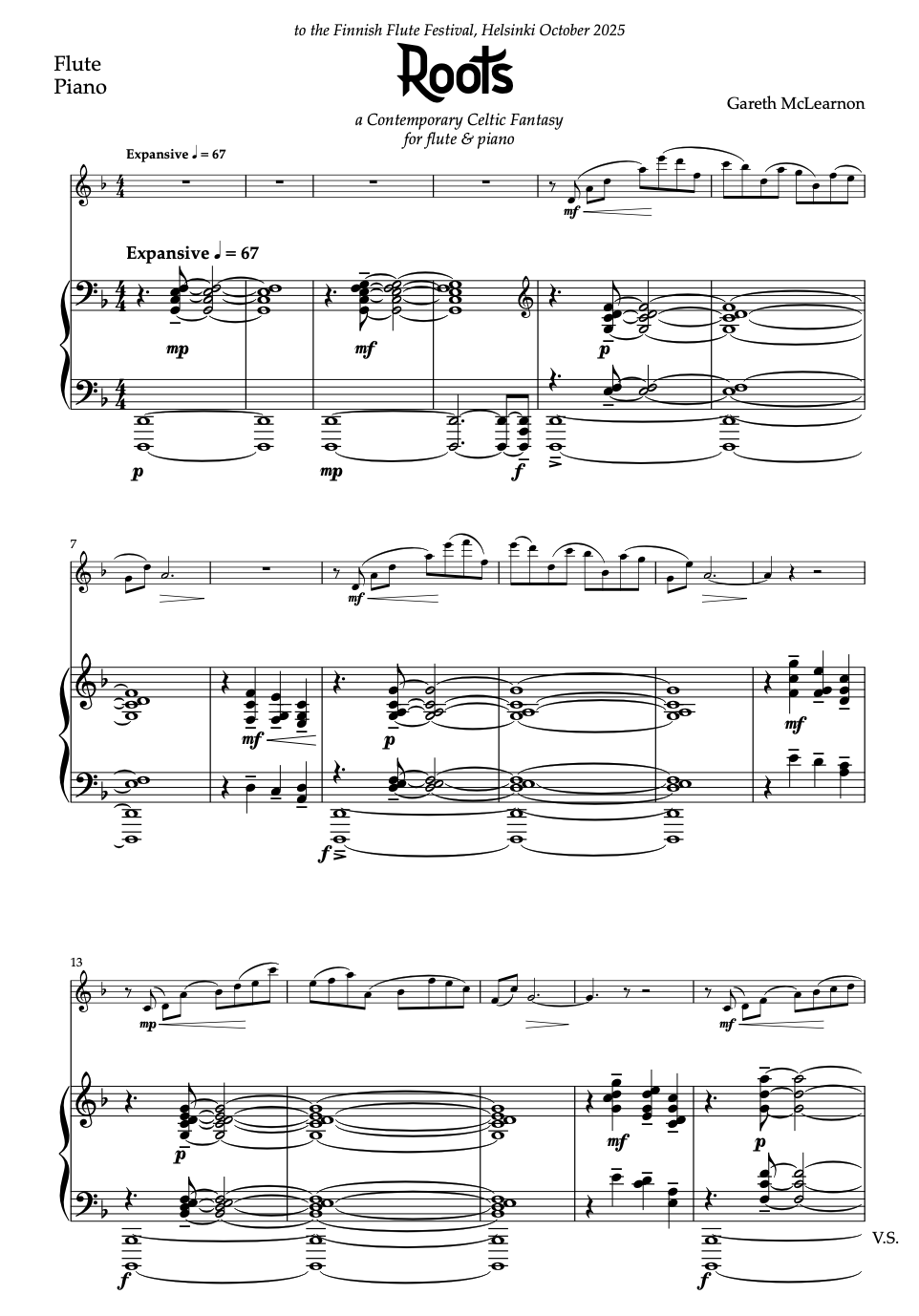
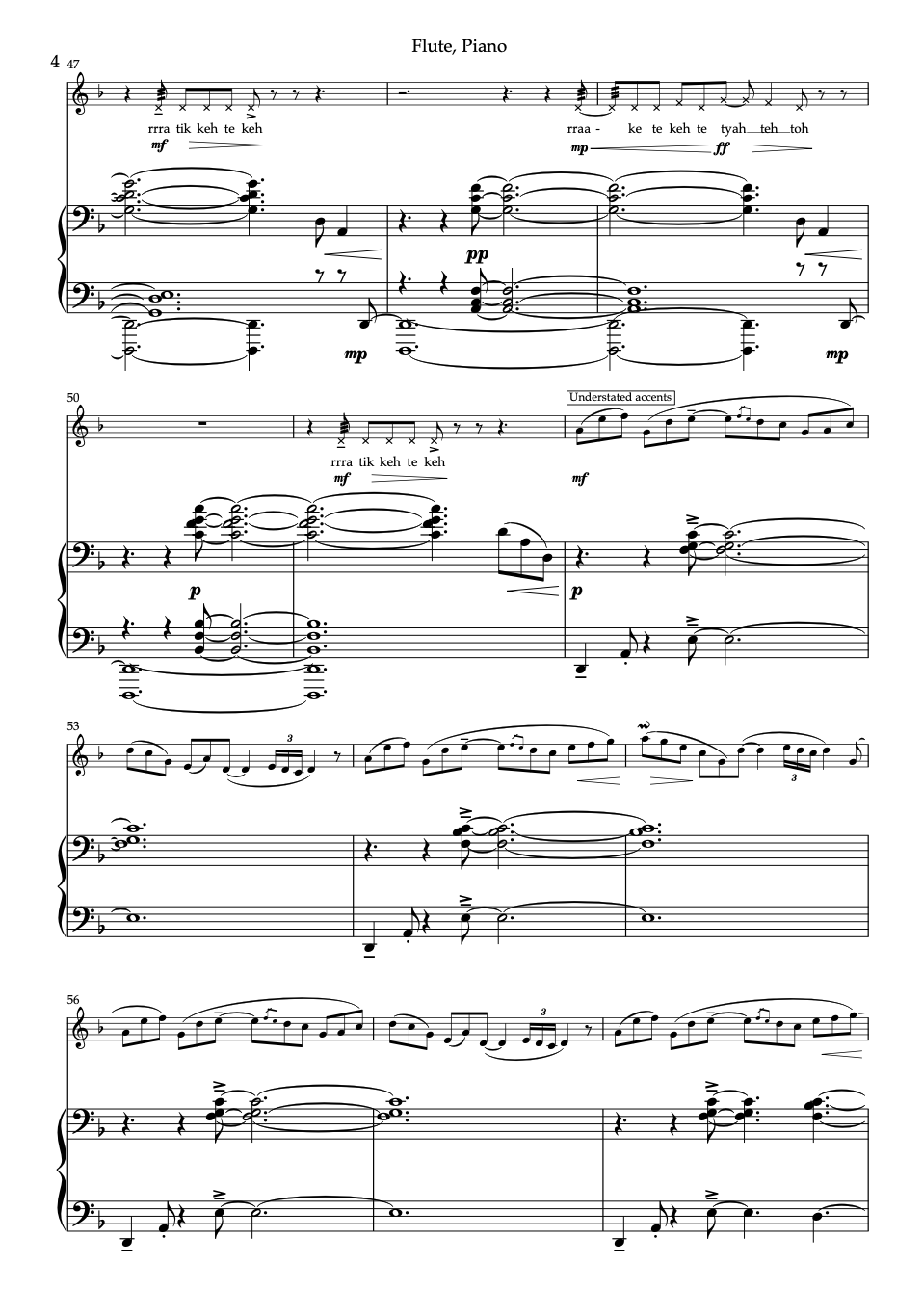


"Roots" for Flute & Piano (2025)
Roots
Roots is an eight-minute Contemporary Celtic Fantasy for flute and piano, conceived as a 21st-century response to Hamilton Harty’s In Ireland.
It moves from a dark, searching and expansive opening into an original 12/8 jig, the opening material then returns in a much wilder and more impassioned form, then strips everything back for a rough-edged 4/4 reel before driving towards the sort of ending I particularly enjoy writing: maximum energy, maximum commitment, and a fourth-octave D designed to send the audience home with a grin on their faces.
The melodies are original. The Irish influence is not about quoting folk tunes, but about taking the rhythmic energy, ornamentation, changing light and shade, and increasingly adventurous harmonic language of contemporary Irish music and bringing it into the modern flute recital.
Quick Details
Flute & Piano
Duration: approximately 8 minutes
Advanced
Best suited to college/conservatoire level, professional players and exceptionally strong pre-college flutists
Contemporary Celtic Fantasy
Original 12/8 jig and 4/4 reel
Strong focus on low-register playing, stamina, breathing and rhythmic precision
Sophisticated, rhythmically and harmonically substantial piano part
Extended techniques include:
Explosive Articulation
Feathered microtonal trills / finger vibrato
Harmonic Bursts
Harmonic tremolo
“Hot Trills”
deliberately rough/split flute sounds
foot stamping (piano part - and flute part if you’re feeling adventurous)
percussion on the body of the piano (piano part)
World premiere: Finnish Flute Festival, Helsinki, 4 October 2025
Premiere reel featured Irish dancer Heidi Aaltonen of Inspiral Irish Dance School
Subsequently performed extensively throughout Europe, Africa and the United States
US/NFA performance: Portland, Oregon, August 2026
Already in its fourth print run
Why Roots?
I had wanted a modern equivalent to Hamilton Harty’s In Ireland for years.
I first heard Harty’s piece when I was about twelve or thirteen, and it has remained part of my performing life ever since. Other than Danny Boy, it is probably the piece I have performed most frequently in recitals.
What I wanted was something with a similar place in a programme, but which reflected the extraordinary development of Irish music since Harty’s time.
I even wrote to Bill Whelan twice, asking whether he already had something suitable or might consider writing something in that vibrant, rhythmically complex contemporary Irish style. Sadly - I never heard back.
Eventually a thought occurred to me: I am a contemporary Irish composer.
People seem to enjoy my music. I enjoy performing my music.
Perhaps I should just write this myself.
And so I did.
A Response to In Ireland, Not a Rewrite
The connection with Harty is primarily one of form and purpose.
Both pieces begin expansively, move into dance material, return to something broader and more impassioned, and ultimately race towards an exhilarating finish.
There are no borrowed melodies from In Ireland in Roots.
Nor are the jig and reel traditional Irish tunes.
In fact, while writing them I became slightly paranoid that I might have unconsciously reinvented something that already existed. Traditional Irish music contains an enormous number of tunes, many of which have existed and evolved orally for generations.
So I asked dear friend, exceptional flutist and traditional Irish music specialist Philippe Barnes to check them.
Thankfully, my jig and reel survived the inspection. They really are mine!
Irish Roots
The title isn't particularly cryptic.
They're my Irish roots.
I grew up in Northern Ireland, learnt traditional music by ear from childhood, played penny whistle before my musical life became completely dominated by the flute, and Irish repertoire has followed me throughout my performing career.
But Roots isn't intended to be a nostalgic reconstruction of traditional Irish music. It is about where that musical language can go now.
The influence includes traditional rhythmic and melodic gestures, but also the complex rhythms, rich extended harmonies and enormous stylistic confidence that have become such a recognisable part of modern Irish music.
Darkness and Light
The opening of Roots is deep, dark and reflective. It reaches outward. It searches.
There is optimism in it, but not uncomplicated optimism.
The first part remains relatively pure in sound. Then the characteristic Irish colouring begins to emerge through feathered notes, finger vibrato and tiny microtonal inflections.
The music is “gradually revealing” where it comes from.
That movement between darkness and sunlight continues throughout the whole piece.
Both the 12/8 jig and later 4/4 reel deliberately move between major and minor.
It reminds me of Irish weather. Darkness. Sudden sunlight. Back to darkness. Then somehow bright again five minutes later.
The Jig
The first substantial dance section is an original 12/8 jig.
It has the propulsion and lilt of Irish dance music, but it sits inside a much broader contemporary harmonic language.
Major and minor constantly colour one another.
The rhythmic writing is energetic but not simply decorative. It is part of the character of the music itself.
This was one of my main ambitions for Roots: I didn't want to write a classical flute piece with a bit of Celtic seasoning sprinkled over it.
I wanted the Irish rhythmic language to be inside its DNA.
A Cry From the Soul
After the jig, material from the opening returns. But it no longer behaves politely.
What had previously been expansive and searching becomes much larger, wilder and more emotionally exposed. It is the first genuinely fortissimo moment in the piece. If it is being played properly, this is where I want the goosebumps.
For me, this section is simply: a cry from the soul.
The Reel
And then everything disappears. The texture suddenly collapses to a single flute line.
The pianist stops being a pianist and becomes a percussionist, striking the body of the instrument while the flute begins the reel alone.
I normally play this passage extremely roughly. I deliberately allow notes to split with my tone jumping unexpectedly between octaves.
I don't want refinement. I want something raw, visceral and almost unruly.
Then the piano finally rejoins. And somehow its arrival feels like a calming influence. The flute has been allowed to run feral for a while. Now somebody responsible has entered the room.I can start behaving slightly more civilly.
(Slightly.)
The reel is also listed as “slightly swung 16th notes” - this is to engender a nice groove that should have your audience’s toes tapping along.
“Hot Trills” and Irish Ornament
One of the techniques in Roots is something I call a Hot Trill.
The trill keys are brushed extraordinarily lightly and rapidly, barely opening at all. Instead of producing a conventional classical trill, the effect creates a little splash or flicker in the sound.
For me it immediately evokes something of the articulation and ornamentation of Irish traditional flute playing without attempting to imitate a wooden simple-system flute literally on a modern Boehm instrument. Alongside these are feathered microtonal trills and finger vibrato, which introduce tiny instabilities and bends into what might otherwise be an overly pristine classical flute sound. The aim isn't novelty.
It's accent, character and authenticity.
Extended Techniques
The extended techniques in Roots are used for colour and character rather than as effects for their own sake.
They include:
Explosive Articulation
Feathered Microtonal Trills / Finger Vibrato
Harmonic Bursts and Tremolo
Hot Trills
Rough and Split Sounds
Foot Stamping and Piano Percussion
Writing Flute First
Curiously, Roots also changed the way I compose.
Partway through writing it, I became stuck.
I was trying to create the flute and piano parts simultaneously, and the piece was arriving only in fits and starts. Every decision seemed dependent on another decision and the whole process began to feel unnecessarily complicated.
So I went for a bike ride.
No podcast.
No music.
Just thinking.
And suddenly I remembered how I had written my collection of traditional Irish arrangements, Round Ireland with a Flute, published by Theodore Presser in 2008.
I let the flute part lead. For these arrangements - the flute part (melody) already existed - I just had to write the piano part that complimented and contrasted it.
That was the breakthrough.
I stopped trying to solve the whole texture simultaneously and allowed myself simply to write the flute line.
Suddenly the music flowed.
The piano then developed around it, complementing, supporting, challenging and interacting with the flute rather than dictating what the flute was allowed to do.
I've written flute/piccolo/alto flute/bass flute-and-piano music that way ever since.
The Piano Part
The piano is not just accompaniment. It is sophisticated, rhythmically complex and harmonically substantial, with plenty for a good pianist to enjoy.
But I am also quite happy to admit that the flute is kind of the star.
The compositional process deliberately started with the flute's musical journey, and the piano provides the environment in which that journey can happen.
Difficulty
Roots is an Advanced work.
It is most naturally suited to conservatoire/college students and professional flutists, although an exceptionally strong pre-college player with good stamina could certainly tackle it.
The biggest challenges are:
strong and projected low-register playing
stamina across an energetic eight-minute arc
sophisticated breath management
rhythmic accuracy
technical fluency
control of the extended techniques
preserving freedom and spontaneity without losing ensemble precision
This is not intended to sound cautious.
The player needs enough technical security to be able to let the music off the leash.
World Premiere in Helsinki
Roots received its world premiere at the Finnish Flute Festival in Helsinki on Saturday 4 October 2025.
It was quite a weekend.
Aurora was also receiving its extraordinary double world premiere between Helsinki and Sydney, while Roots was appearing for the first time in my recital.
For the reel, I was joined by Heidi Aaltonen of Inspiral Irish Dance School, performing a soft-shoe reel.
It was fab.
And that experience confirmed something I had hoped while writing it: Roots works particularly well as a concert closer.
The dancer is not required, but if you have access to a good Irish dancer, sufficient stage space and enough rehearsal time, I wholeheartedly recommend it.
I would have one at every performance if logistics allowed.
From Helsinki to the World
Since October 2025 I have performed Roots at festivals and flute events including:
Finnish Flute Festival, Helsinki
French Flute Convention, Paris
Polish Flute Meeting, Katowice
Croatian Flute Festival
Flautando, Boswil, Switzerland
South African Flute Festival
Tampere Flute Festival, Finland
International Flute Seminar Bruges
National Flute Association Convention, Portland, Oregon
and it continues to travel.
It is also already in its fourth print run, which has been a particularly lovely response to a piece that began simply because I wanted something I couldn't find in the repertoire.
Cobus du Toit
I wrote y alto flute and piano piece Saudade for my friend and colleague Cobus du Toit, and Roots has subsequently become part of his own recital repertoire as well.
Cobus has performed the piece repeatedly in South Africa and recorded it with pianist Eugene Joubert. (as did I in Johannesburg in March!)
I particularly enjoy that Saudade and Roots now regularly coexist in his programmes, because although they occupy very different musical worlds, both are pieces in which I've tried to give the flute a very strong, personal narrative voice.
Frequently Asked Questions
How long is Roots?
Approximately 8 minutes.
What level is it?
Advanced. It is best suited to college/conservatoire and professional players, although a particularly strong pre-college flutist could tackle it.
Does Roots use traditional Irish melodies?
No. The jig and reel are original melodies. Because traditional Irish repertoire is so extensive, I specifically asked traditional Irish music specialist Philippe Barnes to check that I had not inadvertently recreated an existing tune.
Does Roots quote Hamilton Harty's In Ireland?
No. The relationship is structural and conceptual rather than melodic. Roots was conceived as a contemporary response to the role In Ireland occupies in the flute recital repertoire.
Is an Irish dancer required?
No. But the world premiere featured Heidi Aaltonen performing a soft-shoe reel during the final section, and it works spectacularly well if the logistics allow it.
How difficult is the piano part?
It is sophisticated and substantial, with rhythmically and harmonically complex writing. The flute nevertheless remains the principal solo voice.
Is the music genuinely Irish in style?
The piece grows directly from my own Irish musical background, but it deliberately combines traditional rhythmic and ornamental influences with contemporary harmony, extended flute colour and the rhythmic sophistication of modern Irish music.
Does it work as a concert closer?
Very much so.
That was the plan.