Seconds on State Street for Flute Ensemble (2026)
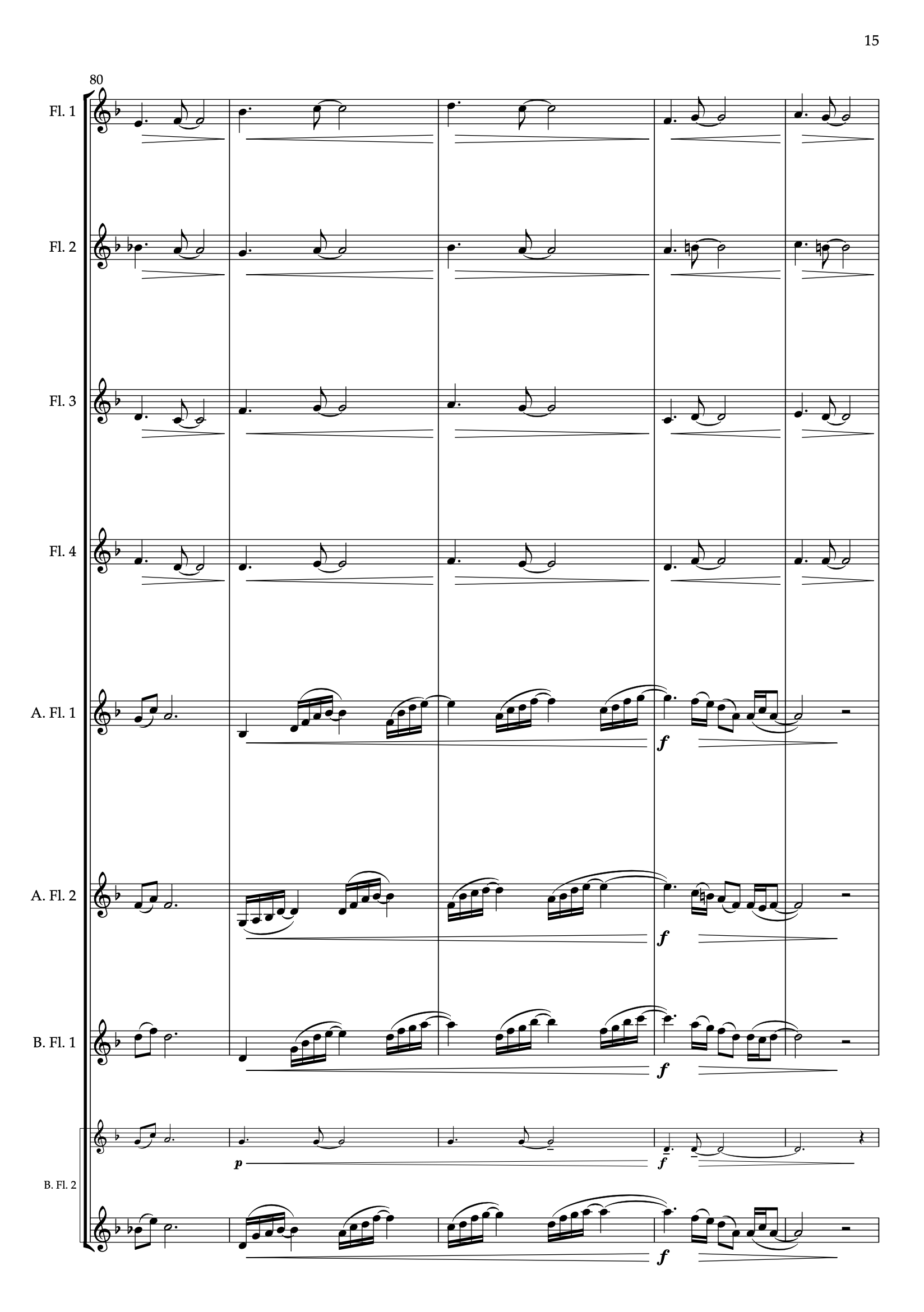
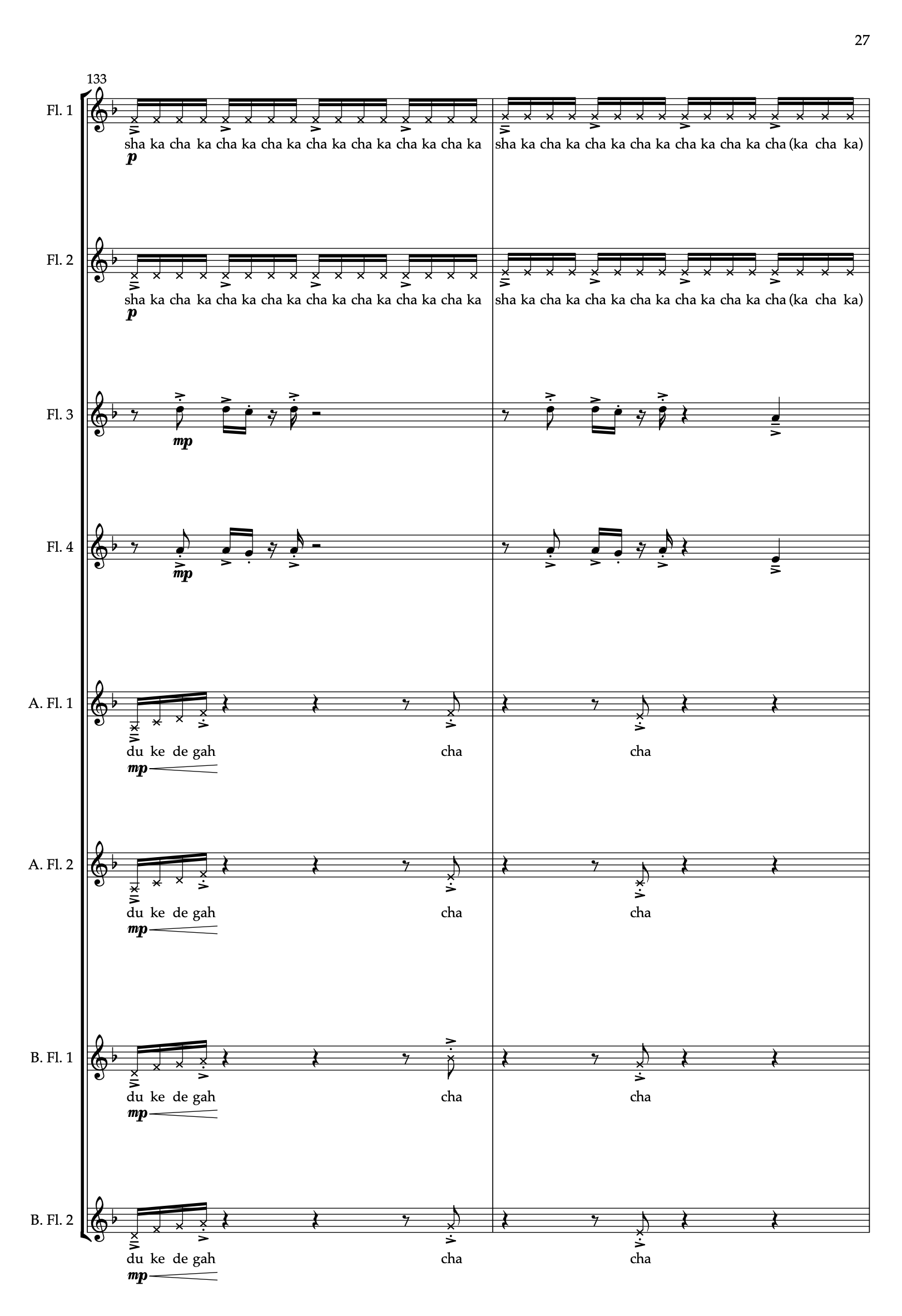
Seconds on State Street for Flute Ensemble (2026)
Seconds on State Street
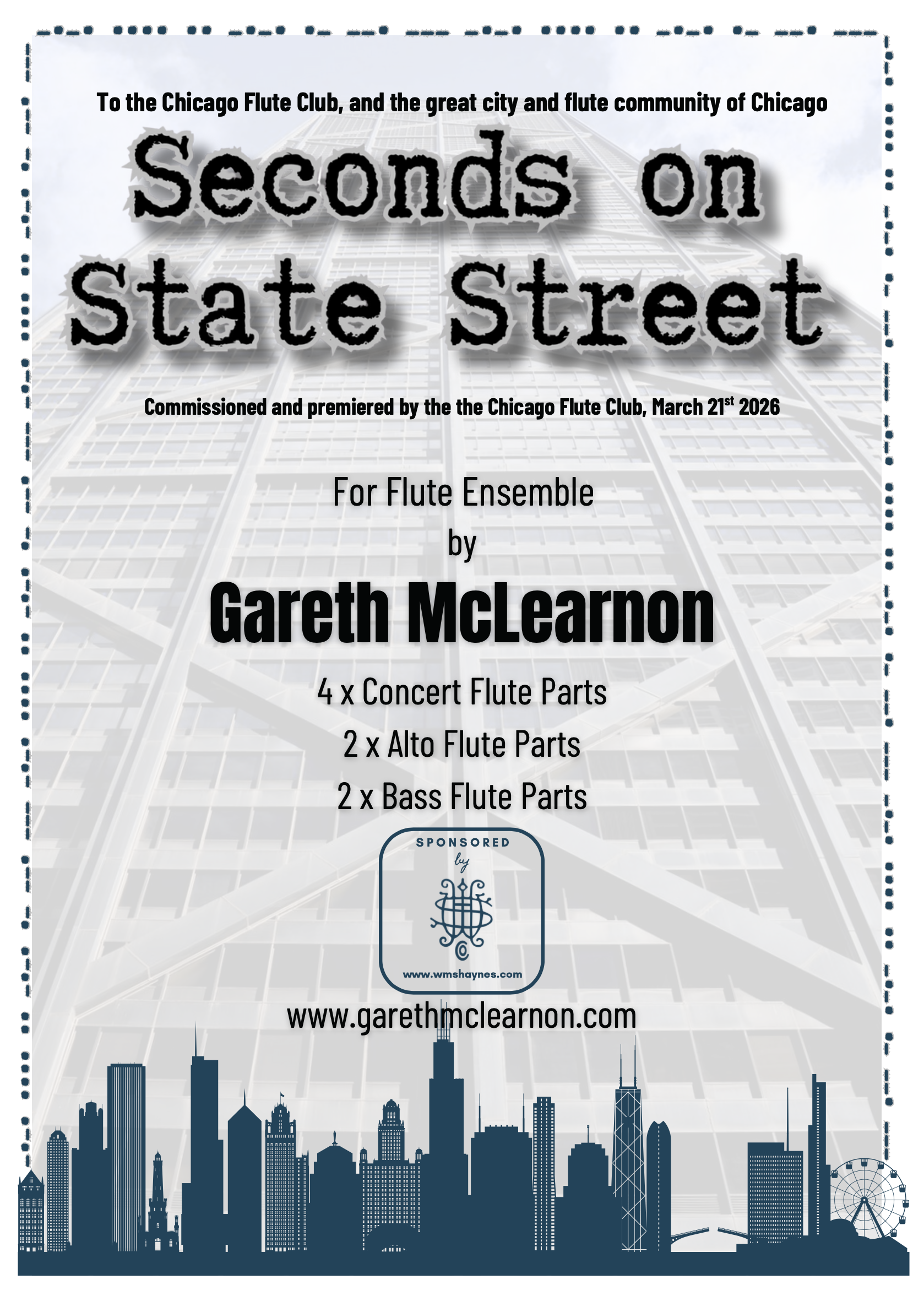
Seconds on State Street is a rhythmic, cool and slightly bluesy work for flute ensemble, written for and commissioned by the Chicago Flute Club.
The piece is unmistakably about Chicago, but not in a literal postcard sort of way. Its musical DNA comes from a mixture of wordplay, Morse code, major seconds, food culture, low-flute colour and a rhythmically exuberant celebration of the city itself.
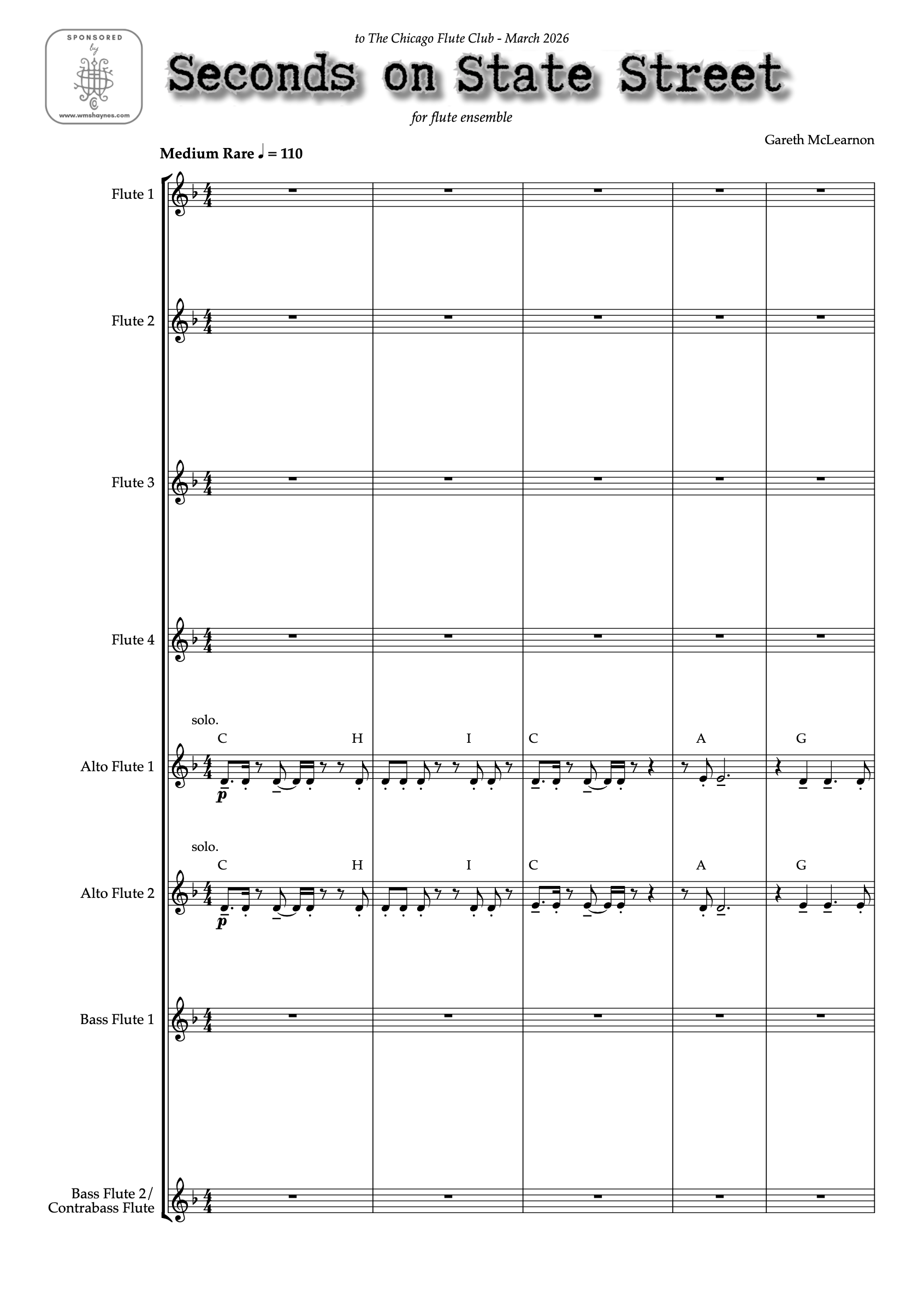
It begins almost like a beacon or signal, built around the interval of a major second. That opening idea eventually became the basis for a rhythmic spelling of C-H-I-C-A-G-O in Morse code, which runs through the piece in several different forms.
As with much of my ensemble writing, the four concert-flute parts are deliberately split between two Advanced parts and two more accessible Intermediate parts. But after becoming increasingly addicted to the thicker low end I had explored in Aurora and DEEP DISH, I doubled the Alto and Bass Flute writing here, allowing for a richer, deeper and more harmonically complex ensemble sound.
The piece lasts approximately 6 minutes, is highly rhythmic throughout, becomes increasingly exuberant as it progresses, and naturally finishes with a BAM!
Quick details
Flute ensemble / flute orchestra
Duration: approximately 6 minutes
Commissioned by the Chicago Flute Club
Four concert-flute parts
Flutes 1 & 2: Advanced
Flutes 3 & 4: Intermediate
Two Alto Flute parts
Two Bass Flute parts
Optional Contrabass material
Rhythmically driven, slightly bluesy and ultimately celebratory
Built around C-H-I-C-A-G-O in Morse code
Features the Windy City Technique
Includes Explosive Articulation
World premiere: Chicago, 21 March 2026
Second performance: Raleigh, 22 March 2026
European premiere: Barbican Centre, London, 26 March 2026
Printed score purchasers can request complimentary PDF individual flute parts
Instrumentation & player levels
Flute 1
Advanced – Advanced High School / Pre-CollegeFlute 2
Advanced – Advanced High School / Pre-CollegeFlute 3
Intermediate – Strong Middle SchoolFlute 4
Intermediate – Strong Middle SchoolAlto Flute 1
AdvancedAlto Flute 2
AdvancedBass Flute 1
AdvancedBass Flute 2
Advanced, with optional Contrabass material
The four concert-flute parts follow a principle that runs through much of my ensemble writing: Flutes 1 and 2 carry the more demanding material, while Flutes 3 and 4 are deliberately more approachable.
My aim is always for every player to feel engaged and stretched, but nobody to feel overwhelmed. The more accessible parts are never simply filler, and every player remains musically involved in the character and momentum of the piece.
The doubled Alto and Bass writing represents something of an evolution in my flute-orchestra sound. A conventional flute choir naturally becomes harmonically restricted at the bottom because the concert flute stops at around middle C. By using two independent Alto and two independent Bass Flute parts, I can build much thicker chords and more complex harmony below the concert-flute register.
The result is a richer and, to my ears, much more satisfying bottom end.
About the title and the music
When someone commissions a piece from me, I generally give them a choice.
They can simply give me a title, as happened with Steel City, or, preferably, they can give me a collection of words, phrases, places, images and ideas associated with whatever they want the piece to represent.
The Chicago Flute Club gave me a list which included things such as foodie culture, Michigan Avenue, State Street and Second City.
I immediately liked the word seconds.
It connected several completely different ideas:
Chicago’s traditional identity as the Second City
a musical major second
going back for seconds in Chicago’s formidable food culture
and finally the alliteration of Seconds on State Street
That became the title.
The major second then became something much more important musically.
At the beginning of the piece, I wrote a simple figure using that interval which had the character of a signal or beacon.
Only afterwards did I realise that the rhythm I had instinctively written was also the Morse-code rhythm for the letter C.
That was too good an accident to ignore.
If I already had C, why not carry on?
So I constructed rhythmic material from the Morse-code spelling of:
C-H-I-C-A-G-O
That sequence became the rhythmic backbone of the entire piece.
It first appears in its original form. Later, the sequence is turned backwards. Towards the end, the original form reappears again, but now quicker, more exuberant and increasingly celebratory.
The piece therefore grows out of a tiny rhythmic signal into something much larger, more energetic and unmistakably Chicagoan.
Extended techniques
Seconds on State Street includes:
Windy City Technique – expressive, gentle jet-whistling used to create the impression of gusting wind
Explosive Articulation
Chicago → Raleigh → London
Seconds on State Street had an unusually busy first week of life.
Its world premiere took place in Chicago on 21 March 2026, performed by the Chicago Flute Club with me directing.
The following day, 22 March, I directed its second performance at the Raleigh Area Flute Association Flute Day in North Carolina.
Then, just four days after the world premiere, the piece crossed the Atlantic for its European premiere at the Barbican Centre in London on 26 March 2026, performed by students of the Guildhall School of Music & Drama flute department.
So within five days of its first performance, Seconds on State Street had travelled from:
Chicago → Raleigh → London
Which is not a bad first week for a piece of flute choir music.
Printed score + complimentary PDF parts
If you purchase the printed score, you can also request a complimentary PDF set of the individual flute parts during checkout.
These are provided to save conductors and ensemble directors the need to photocopy individual parts from the printed score.
Frequently asked questions
What level is Seconds on State Street?
The concert-flute writing is deliberately mixed-level. Flutes 1 and 2 are Advanced, while Flutes 3 and 4 are Intermediate. The doubled Alto and Bass Flute parts are intended for confident Advanced players.
Why is it called Seconds on State Street?
The title combines several ideas: Chicago as the Second City, the musical interval of a major second, going back for seconds in the city’s food culture, and the alliteration of Seconds on State Street.
What does Morse code have to do with the piece?
A major-second figure at the beginning happened, quite accidentally, to use the Morse-code rhythm for C. I then created rhythmic material from the Morse-code spelling of C-H-I-C-A-G-O, which became one of the central ideas of the whole work.
What is the Windy City Technique?
It is an expressive, gentle jet-whistle effect used to create the impression of gusting wind, a fairly obvious nod to Chicago’s famous nickname.
Why are there two Alto and two Bass Flute parts?
Using independent low-flute lines allows for considerably richer harmony below the normal concert-flute register. After exploring that thicker sound in Aurora and DEEP DISH, I wanted to make it an important part of the harmonic language of Seconds on State Street.
What is the character of the piece?
It begins cool, signal-like and slightly bluesy, becomes increasingly rhythmic and energetic, and eventually returns to its central Chicago rhythm in a faster, more exuberant and celebratory form.
How long is Seconds on State Street?
Approximately 6 minutes.
Are individual PDF parts available with the printed score?
Yes. Purchasers of the printed score can request complimentary PDF individual flute parts when ordering.